Buying Guide
Pickleball Paddle Spin Ratings, Explained
Spin charts, RPM numbers and spin-test spreadsheets are everywhere, and they do not agree with each other. Here is what the numbers actually measure, when to trust them, and the three things that decide spin far more than any rating does.
The short answer
A paddle spin rating is almost always a measurement of revolutions per minute imparted to the ball by a mechanically repeated brushing stroke, produced by an independent reviewer with a launcher, a high-speed camera and a spreadsheet. It is a real measurement of a real property, and it is useful for rankingpaddles against each other within one tester's data set.
It is close to useless for comparing numbers across testers, and it tells you nothing about how much spin you will generate. The ceiling is set by the paddle; the actual number is set by your swing. A 4.5 player with a mid-table paddle will out-spin a 3.0 player with the highest-rated paddle on any chart, every single time.
What a spin rating actually measures
The standard independent method works like this. A ball is fired at the paddle face, or the paddle is swung mechanically through a ball, at a fixed speed and a fixed brushing angle. A high-speed camera records the ball leaving the face, and the rotation is counted and converted into RPM— typically somewhere between about 1,400 and 2,400 RPM for current paddles under one common protocol.
Two other numbers often appear next to it. Surface roughness, usually quoted in micrometres as an Rz or an average roughness figure, is a direct measurement of the face texture with a profilometer. That is the number USA Pickleball cares about, because it is what certification limits. Coefficient of friction describes how much the face grips, measured with a sled or a drag test.
Roughness and friction are properties of the paddle. RPM is a property of the paddle plusthe stroke used to measure it — which is the root of every problem on this page.
Why the numbers disagree
Put two spin charts side by side and the same paddle will often appear with numbers 20 percent apart, sometimes in a different rank order. Four reasons, none of them dishonesty.
Different protocols. Brushing angle, impact speed, where on the face the ball lands and which ball is used all change the result. There is no governing-body standard for a spin test the way there is for surface roughness, so each tester invents a repeatable method and sticks to it. Internally consistent; mutually incomparable.
Break-in and wear.A raw carbon face is at its grippiest when new and polishes smoother with every hour of play. A paddle measured fresh out of the plastic and the same model measured after ten sessions are genuinely different paddles. Charts rarely say which they used, and this is also why your paddle spins less than it did in June — see paddle care and cleaning.
Unit variation. Especially on budget and marketplace paddles, two copies of the same model can differ in face finish. One sample is one sample.
Mid-production changes. Manufacturers revise faces and resins without renaming the paddle. A chart entry from eighteen months ago may describe a paddle you can no longer buy.
The legality ceiling nobody mentions
Here is the context that makes most spin charts less dramatic than they look. USA Pickleball limits surface roughness on approved paddles, and every certified paddle has to pass that test. So the entire legal market is squeezed into a narrow band of face texture, and the spread between the grippiest legal paddle and a mid-table legal paddle is much smaller than a bar chart with a truncated axis makes it appear.
That limit is also why the aftermarket "spin spray", grit paint and stick-on grit sheets that show up in autocomplete are a bad idea: applying them to a certified paddle voids its approval, and in sanctioned play that makes the paddle illegal regardless of what it does for your topspin. Our USA Pickleball approval guide explains how to check the current list for a specific model.
Practical consequence: treat a spin chart as a way to avoid the genuinely low-spin paddles — smooth fiberglass faces, worn-out graphite — rather than as a way to chase the top of the table. The difference between first and tenth in a legal field is small. The difference between first and a smooth composite paddle is enormous.
The three things that actually decide spin
1. Face material, and whether it is raw.This is most of it. Raw carbon fiber — where the weave is exposed rather than coated — has a microscopically rough surface that grips the ball. Sprayed, painted or peel-coat textured faces grip less and smooth out faster. Fiberglass grips least and is lively rather than grippy. Our carbon vs fiberglass guide has the detail, and best carbon fiber paddles is the shortlist.
2. Your swing path. Spin comes from brushing across the ball, not from hitting it. A fast, low-to-high path with a quiet wrist generates topspin; a flat swing on the grippiest face in the world generates almost none. This is the variable with by far the largest range in real play, and it is free. If you want more spin this month, this is the only item on the list that will deliver it.
3. Face wear and cleanliness.A dirty or polished face grips far less than a clean, fresh one. Wiping a raw carbon face between sessions is the cheapest spin upgrade available, and face texture is a consumable — see how long paddles last.
Two things that do not decide spin, despite appearing in every forum thread: core thickness(a 16mm paddle does not out-spin a 14mm one of the same face — dwell time helps marginally, the face does the work) and paddle shape (an elongated head gives you more tip speed for the same hand speed, which is a leverage advantage, not a grip one).
How to use a spin chart properly
Four rules that make the numbers useful instead of misleading.
Compare within one tester, never across them. Rank order inside one data set is meaningful. The absolute numbers are not portable.
Look at the gap, not the position. If the paddle you want is within a few percent of the top, that difference will not survive contact with your technique.
Check the date and the sample. A two-year-old number on a paddle that has been revised is fiction.
Read the face spec first. If the spec says raw carbon, the paddle will be near the top of any chart. If it says fiberglass or a painted texture, it will not. You can predict most of a spin chart from the materials column alone, which tells you how much information the chart is really adding.
Paddles that spin, and why
Three paddles we carry that are near the top of any spin ranking, chosen to show the different ways manufacturers get there. In every case the reason is the face, not a rating.
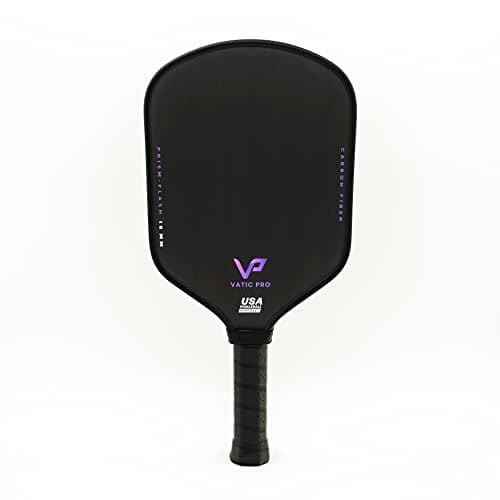
Vatic Pro Prism Flash 16mm— who it is for: the player who wants the most spin per dollar in pickleball. A raw Toray T700 carbon face with heat-compressed texturing over a 16mm core with foam-injected walls. Raw carbon is the material that grips, heat-compressed texturing is how Vatic Pro gets grit without a coating that wears off, and the price is roughly half what that specification costs elsewhere. The honest caveat is the one that applies to every raw face: it is grippiest when new, and it polishes.
| Surface | Raw Toray T700 carbon, heat-compressed texturing |
|---|---|
| Core | 16mm with foam-injected walls |
| Shape | Elongated, 16.2 in x 7.7 in |
| Grip | 4.125 in circumference; 5.3 in standard handle |
| Weight | About 7.9 - 8.2 oz (16mm) |
| Certification | USA Pickleball approved; paddle cover included |
Ronbus R1.16 Nova— who it is for: the player who wants a raw carbon face on the cheapest serious chassis available. Raw Toray T700 again, this time on a thermoformed 16mm unibody with an edge grid. It demonstrates the point of this page neatly: its spin comes from exactly the same material as paddles costing three times as much, so it sits high on spin charts despite being a budget paddle. The caveat is brand scale — Ronbus is direct-to-consumer, with the delamination caveat that applies to all thermoformed foam-wall builds.
| Surface | Raw Toray T700 carbon fiber |
|---|---|
| Core | 16mm polypropylene honeycomb, thermoformed |
| Shape | Elongated with edge grid |
| Construction | Unibody thermoformed with foam perimeter |
| Certification | USA Pickleball approved |
CRBN TruFoam Genesis— who it is for: the 4.5-plus player who wants a grippy face on a solid-foam core. A carbon fiber face over a 100 percent foam corein CRBN's hybrid AeroCurve shape. Worth including here because it shows what the core does and does not contribute: the foam core changes dwell time, feel and sweet-spot size substantially, and changes the spin ceiling very little. The caveats are price and the fact that long-term durability of solid-foam cores over several seasons is not yet proven.
| Surface | Carbon fiber |
|---|---|
| Core | 100% foam core |
| Shape | Hybrid AeroCurve |
| Tier | Premium |
| Best for | Modern power with a big sweet spot |
| Paddle | Face | Why it spins | Main caveat |
|---|---|---|---|
| Vatic Pro Prism Flash 16mm | Raw T700, heat-compressed texture | Grit is in the material, not a coating | Polishes smoother over seasons |
| Ronbus R1.16 Nova | Raw Toray T700 carbon | Same raw material at a budget price | Direct-to-consumer support; foam-wall build |
| CRBN TruFoam Genesis | Carbon fiber on a solid foam core | Grippy face; core changes feel, not grip | Price; solid-foam longevity unproven |
The bottom line
Spin ratings measure something real and are worth a glance, as long as you compare within one tester's data, read the gap rather than the rank, and remember that certification squeezes every legal paddle into a narrow band of face roughness. Use a chart to rule out the genuinely low-spin paddles, not to chase the top of the table.
Then shop on the face spec, which predicts most of the chart anyway: buy raw carbon, keep it clean, replace it when the texture is gone, and spend your energy on a faster low-to-high swing path. That last one is free and it moves the number further than any purchase will. If you want the shortlist, best paddles for spin is ranked on exactly these criteria.
Frequently asked questions
What is a pickleball paddle spin rating?
It is almost always a measurement of revolutions per minute imparted to the ball by a mechanically repeated brushing stroke, recorded with a high-speed camera by an independent reviewer. Current paddles typically land between roughly 1,400 and 2,400 RPM under one common protocol. Some charts also publish surface roughness in micrometres, which is a more direct measurement of the face texture itself.
Why do paddle spin charts disagree with each other?
Because there is no standard spin test. Each tester chooses their own brushing angle, impact speed, contact point and ball, so the numbers are internally consistent but not comparable between sources. Face break-in makes it worse - a raw carbon face is grippiest brand new and polishes smoother with use - as does unit-to-unit variation and manufacturers revising faces without renaming the paddle.
Does a higher spin rating mean more spin for me?
Only as a ceiling. The paddle sets the maximum grip available; your swing path decides how much of it you use. Spin comes from brushing up the back of the ball with a fast, low-to-high path - a flat swing on the grippiest face on any chart produces very little. A better player with a mid-table paddle will out-spin a weaker player with the top-rated one every time.
Does core thickness affect spin?
Barely. A thicker 16mm core holds the ball on the face a fraction longer, which helps marginally, but spin is overwhelmingly a property of the face. A 14mm raw carbon paddle will out-spin a 16mm fiberglass one comfortably. Core thickness changes the power-versus-control feel, not the grip.
Can you add grit to a paddle to increase spin?
You can, and you should not on a paddle you play sanctioned events with. USA Pickleball limits surface roughness on approved paddles, and applying spin spray, grit paint or stick-on grit sheets to a certified paddle voids its approval - which makes it illegal for sanctioned play whatever it does for your topspin. Cleaning the face you already have is the legal version of the same idea.
Which pickleball paddle has the most spin?
No single answer survives across testers, which is the point of this page - but every paddle near the top of every chart has a raw carbon fiber face, because the exposed weave is what grips the ball. Among the paddles we carry, the Vatic Pro Prism Flash with its heat-compressed raw T700 face is the most spin per dollar, and the Ronbus R1.16 Nova gets there on the same material for less.
Sources
Keep reading
Upgrading your paddle or gearing up to play?
See how we pick, then dig into the paddle roundups and buying guides — honest picks from someone who actually plays, with no inventory to move.