Comparison Guide
JOOLA vs Paddletek: Which Brand Suits Your Game?
One brand releases a new flagship every few months and has a pro's name on the throat. The other has sold basically the same two paddle families out of Michigan for a decade. That is the whole comparison, and it is more useful than any spec sheet.
JOOLA and Paddletek are both excellent paddle companies that have almost nothing in common. One is a global table-tennis giant that entered pickleball in 2021, signed the best player in the world, and has iterated relentlessly ever since. The other has been quietly making paddles in Niles, Michigan since 2010, with a range that would be recognizable to someone who last shopped in 2018.
That is not a "modern versus old-fashioned" story, which is how it is usually told. It is a genuine difference in what each company optimizes for, and once you see it the choice becomes straightforward.
The short answer
| JOOLA | Paddletek | |
|---|---|---|
| Optimizes for | Spin, pace, being first to new technology | Consistency, control feel, longevity of design |
| Feel | Firmer, livelier, faster off the face | Softer, quieter, longer dwell |
| Range logic | Signature athlete lines x generations | Two core families (Bantam, Tempest) x models |
| Release pace | Fast — expect your model to be superseded | Slow — models stay in the range for years |
| Best for | Aggressive players who want current tech | Touch players who want a paddle that never surprises them |
| Start with | Scorpeus Heat Vision 16mm | Tempest Wave PRO-C |
Two opposite bets
JOOLA bets on iteration.The company brought a table-tennis product cycle to pickleball: new face treatments, new core generations, new signature models, several times a year. That has genuinely advanced the sport — JOOLA has been early to several construction ideas the rest of the industry then adopted. The cost is churn. A paddle you love may be a generation behind within a year, and the successor will not feel identical.
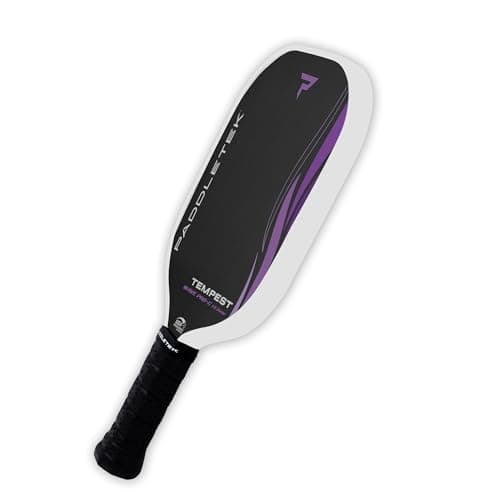
Paddletek bets on stability. Bantam and Tempest have been the two families for over a decade. Models get carbon updates and thickness variants, but the fundamental character does not move. If you buy a Tempest today it will feel like the Tempest you played three years ago, and you will be able to replace it with something familiar in three more.
Where the difference actually lives
It is in the core, not the face. Both brands use good carbon faces; both offer 14mm and 16mm options. What separates them is how the core is tuned.
JOOLA cores return energy.The Propulsion and charged-core constructions in JOOLA's current range are built to give more of the impact back to the ball. That produces pace on drives and dipping topspin from a full swing, and it is why JOOLA paddles feel fast.
Paddletek cores absorb it.Bantam PolyCore and the Tempest core are Paddletek's own polymer formulations, tuned for dwell — the ball sits on the face fractionally longer, which is what makes placement feel easy. The muted, slightly "dead" feel players describe is that absorption working.
Everything else follows from that one choice. Faster core, harder resets to control. Softer core, less free power. The trade-off is the same one covered in our 14mm vs 16mm guide, applied at the level of a brand's entire design language.
Making sense of the ranges
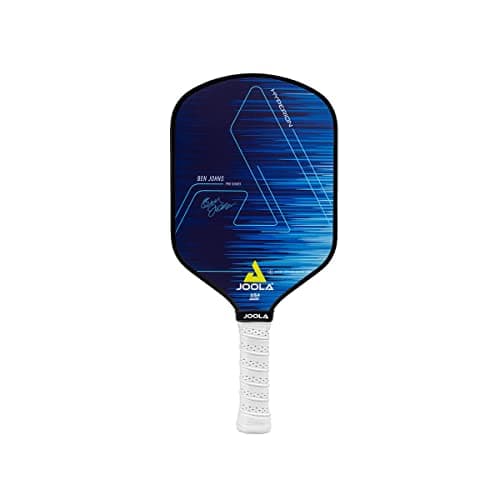
JOOLAorganizes by athlete and generation. Hyperion and Perseus are Ben Johns' lines; Scorpeus is Collin Johns'; Agassi is Andre Agassi's. Suffixes carry the technology — CAS and CFS are face treatments, Pro IV and 3S are generations — and the millimeter number is core thickness. Heat Vision and Double Vision are the accessible current tier.
Paddletek organizes by core family. Bantam is the power family (EX-L, TS-5, TKO-CX, GTO-C). Tempest is the control family (Wave V3, Wave PRO-C, TKO-C). Phoenix is the soft entry line, and Honeyfoam is the newer foam-core family above them. The suffix letters denote the face and construction; the family name is what actually decides how the paddle plays.
Full range maps are in our best JOOLA paddles and best Paddletek paddles roundups.
Price and value
Both brands top out around $250–$300 and both have paddles under $100, but the middle is different.
JOOLA's range is barbell-shaped: strong options around $50–$120 and strong options at $230–$300, with less in between. Paddletek fills the middle better — the Tempest Wave PRO-C sits at around $150, which is exactly the band where JOOLA has fewer natural answers.
Where JOOLA has a real value advantage is superseded flagships. Because the range moves fast, last generation's paddles get cheap while remaining excellent — the Ben Johns Hyperion CAS 16 is the clearest example, and it is one of the best-value premium paddles in the sport for exactly that reason.
Who wins which category
| Category | Winner | Why |
|---|---|---|
| Spin | JOOLA | High-grit carbon faces are the brand's signature strength |
| Touch and resets | Paddletek | Core tuning favors dwell and absorption |
| Power | JOOLA | Energy-returning cores plus elongated shapes |
| Consistency unit to unit | Paddletek | Slow-moving range, in-house cores, US manufacturing |
| Value at the top end | JOOLA | Superseded flagships drop in price and stay excellent |
| Value in the middle | Paddletek | The $130-$160 band is properly served |
| Availability | JOOLA | Far larger distribution and pack presence |
Which paddle to start with
Not the flagships — the paddles that best represent each brand's thinking at a price that does not require commitment.
JOOLA: Scorpeus Heat Vision 16mm.A textured carbon face, a 16mm core, a damping layer and a forgiving standard shape, around $100. It is the most balanced modern JOOLA and the least likely to punish you while you work out whether you like the brand's feel.
Paddletek: Tempest Wave PRO-C.PT-700 unidirectional carbon over the 14.3mm Tempest core with torsional weighting. This is what Paddletek is famous for, undiluted — if you do not like this paddle you will not like Paddletek.
On a tighter budget the equivalent pairing is JOOLA's superseded flagship against Paddletek's long-running value paddle — two very different ways to spend under a hundred and a bit.
So which one?
Buy JOOLA if you want to hit the ball harder and spin it more, if you like knowing your equipment is current, and if a paddle being superseded does not bother you. It is the better brand for aggressive players and the better brand for anyone whose game is still getting faster.
Buy Paddletek if you want a paddle that behaves identically every session, if your points are won with placement rather than pace, and if you would rather buy the same paddle again in three years than learn a new one. It is the better brand for touch players and for anyone who has found something that works and wants to keep it.
If you are genuinely undecided, the tiebreak is your soft game. Play a set and count how many points you lose because a reset floated too high. If that number is large, Paddletek's core tuning will help you more than JOOLA's spin will — and our best control paddles roundup is where to go next.
Frequently asked questions
Is JOOLA or Paddletek better?
They optimize for opposite things. JOOLA tunes cores to return energy, which produces pace and spin, and iterates its range quickly to stay at the front of paddle technology. Paddletek tunes cores to absorb energy, which produces dwell, touch and predictable placement, and keeps models in the range for years. Aggressive players usually prefer JOOLA; touch players usually prefer Paddletek.
What's the difference between Paddletek Bantam and Tempest?
They are two core philosophies, not two price tiers. Bantam is the power family with a firmer core that returns more energy to the ball, suited to drivers and put-away players. Tempest is the control family with a softer core response and longer dwell, suited to players who win at the kitchen line. Phoenix sits below both as the soft entry line and Honeyfoam is the newer foam-core family above them.
Which brand holds its value better?
Paddletek models stay in the range for years, so a paddle you buy today will still be current and replaceable for a long time. JOOLA paddles are superseded faster, which pushes prices down — that is bad for resale value but genuinely good for buyers, since a superseded JOOLA flagship like the Hyperion CAS 16 remains an excellent paddle at a much lower price.
Does Paddletek make a foam core paddle?
Yes — the Honeyfoam family, which uses a multi-foam core with a raw PT-700 carbon face, is Paddletek's entry into the foam-core category that JOOLA, CRBN and others reached first. It is characteristically Paddletek about it: powerful, but less brutal than most foam paddles, because the company's design language is still built around control.
Which is better for beginners, JOOLA or Paddletek?
Paddletek, generally. A softer, more absorbing core makes the soft game easier to learn, and the Phoenix G6 and Bantam EX-L are forgiving, durable and cheap. JOOLA's entry paddles are perfectly good, but the brand's character rewards a developed swing — its faster cores return energy on resets as readily as on drives, which is harder for a new player to manage.
Sources
Keep reading
Upgrading your paddle or gearing up to play?
See how we pick, then dig into the paddle roundups and buying guides — honest picks from someone who actually plays, with no inventory to move.