Comparison Guide
14mm vs 16mm Pickleball Paddles
Two millimeters sounds like nothing. It's the single spec that most reliably predicts whether a paddle will suit your game — and most players buy the wrong one.
Walk into any paddle comparison and you will meet the same two numbers: 14mm and 16mm. They refer to the thickness of the core — the honeycomb or foam structure sandwiched between the two faces — and the difference between them is about the width of a stack of two credit cards.
It is also, for most players, the most consequential spec on the sheet. Not because two millimeters is a lot of material, but because of what it does to the moment of contact.
What the core actually does
When the ball hits the paddle, the core compresses. How much it compresses, and how quickly it springs back, determines two things: how much energy returns to the ball, and how long the ball stays in contact with the face.
A thinner core has less material to absorb energy.More of the ball's incoming energy — and more of your swing's energy — goes straight back out. The result is a faster, poppier ball.
A thicker core absorbs more.More energy is soaked up in the compression, less comes back out, and the ball leaves slower. That is what "control" means in a paddle: predictability, and the ability to take pace off a ball rather than return it.
14mm: power and pop
What you gain. Drives leave faster with less effort. Overheads and put-aways have more finish. Serves come off harder. If your winning pattern is to end points with pace, a thinner core does more of that work for you.
What you give up.Resets and drops. A ball driven hard at you comes off a 14mm paddle fast, and turning that into a soft ball dropping into the kitchen requires real technique — a shorter swing, a looser grip, and hands that can absorb what the paddle won't.
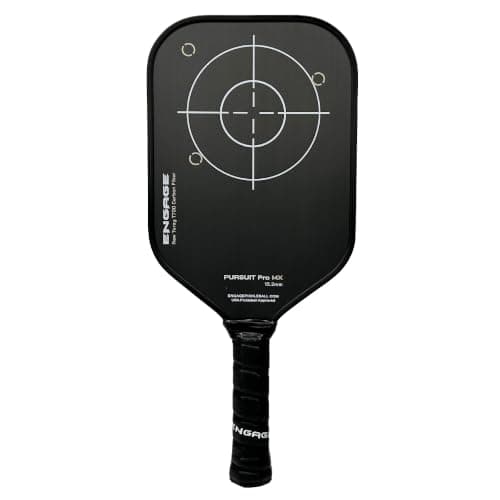
Who it suits. Players with a developed soft game who want more weapon. Singles players, where power pays more. Aggressive doubles players who finish points at the net. Most of the picks in our best power paddles roundup are thin-core or power-tuned builds, and the Engage Pursuit Pro1 takes the idea further with a 12.7mm core.
16mm: dwell and control
What you gain.The soft game. Resets land shorter. Dinks stay lower. Blocks drop at your opponents' feet instead of floating back to them. A thicker core also tends to produce a slightly larger effective sweet spot, because there is more material distributing the load behind the face.
What you give up. Free power. You have to generate your own pace on drives, which for a strong player is fine and for a weaker one is a genuine limitation.
Who it suits. Nearly everyone below 4.5, and a very large share of players above it. Doubles players, where the majority of points are decided at the kitchen line. Anyone still learning to reset. Almost every pick in our control roundup and all-court roundup is 16mm. If you have already decided on the thicker core, our best 16mm pickleball paddles roundup is the shopping list.
Side by side
| 14mm | 16mm | |
|---|---|---|
| Ball speed off the face | Higher | Lower |
| Drives and put-aways | Easier | Requires more swing |
| Resets and drops | Harder | Easier |
| Dwell time | Shorter | Longer |
| Effective sweet spot | Smaller | Slightly larger |
| Shock to the arm | More | Less |
| Typical buyer | Aggressive, singles, developed soft game | Doubles, improvers, control players |
Dwell time, and why 16mm can spin more
Dwell time is how long the ball stays in contact with the paddle face. It matters because spin is generated by friction between the ball and the surface texture — and friction needs contact time to work.
A thicker core compresses more, so the face travels further with the ball and holds it a fraction longer. That extra contact time gives the surface more opportunity to grip. This is why plenty of dedicated spin paddles use 16mm cores despite spin being associated with aggression: a raw carbon face plus more dwell produces more revolutions than a grippy face on a core that spits the ball off immediately.
The complication is that very thin cores can also increase dwell, by flexing more overall — which is the design logic behind sub-14mm paddles. Both extremes can spin well by different mechanisms. What sits in between spins the least.
Which should you buy?
Here is a rule that gets it right more often than any spec comparison:
If you don't already have a reliable reset, buy 16mm.The reset — taking a hard ball and dropping it softly into the kitchen — is the shot that separates levels in doubles, and it is far easier to learn on a paddle that absorbs pace. Buying 14mm before you can reset means fighting your equipment while learning the most important skill in the game.
If you can already reset consistently and your problem is finishing points, consider 14mm. At that stage the extra pace is a weapon rather than an error generator.
If you play mostly singles, lean 14mm. Singles rewards pace and depth more than touch, and there is less kitchen-line play to punish you.
The corollary: if you are new, the answer is 16mm and it is not close. Our best paddles for beginners roundup reflects that, and the full decision framework is in how to choose a pickleball paddle.
If you want a second read before you commit, Drive & Dink's guide to 14mm vs 16mm paddles works through the same trade-off from another player's perspective.
What about 13mm, 19mm and foam?
Sub-14mm (12.7mm, 13mm). Deliberate power-and-dwell designs. The face flexes more overall, which increases contact time and spin while returning a lot of energy. Very demanding on the soft game.
19mm and above.Rare, and aimed squarely at maximum control — usually bought by players whose entire game lives at the kitchen line. They give up meaningful power.
Foam-loaded cores. The current premium direction, where foam is injected into or replaces the honeycomb. Foam changes the compression behavior rather than the thickness, and it can deliver more dwell andmore returned energy at the same time — which is why it costs more. Our best Gen 3 paddles roundup covers the technology, and the CRBN TruFoam Genesis review covers the most extreme version of it.
Core thickness and your arm
A thicker core absorbs more impact energy, and energy absorbed by the paddle is energy that doesn't travel up your forearm. That makes core thickness one of the most effective equipment changes available to a player managing elbow pain — more effective, in most cases, than switching brands or shaving weight.
If your elbow is sore, 16mm is close to a default, and a 14mm power paddle is close to the worst choice you could make. Our best paddles for tennis elbow roundup covers the full set of changes, including grip size and vibration damping, and paddle weight covers the other half of the load question.
Decided which way you are going? The shortlists are best 14mm pickleball paddles and best 16mm pickleball paddles, both ranked on what the thickness actually does rather than on brand.
Frequently asked questions
Is a 14mm or 16mm pickleball paddle better?
Neither universally — they trade in opposite directions. A 14mm core absorbs less energy, so drives and put-aways come off faster while resets and drops become harder. A 16mm core absorbs more, making the soft game far easier at the cost of free power. For most doubles players and anyone still learning to reset, 16mm is the better choice.
Should a beginner use a 14mm or 16mm paddle?
16mm, and it isn't close. The reset — taking a hard ball and dropping it softly into the kitchen — is the most important shot to learn in doubles, and a thicker core absorbs pace to make it achievable. A thin, poppy core means fighting your equipment while trying to develop that skill, and most beginners' errors are already 'too much ball'.
Does a 16mm paddle spin more than a 14mm?
Often, yes. Spin comes from friction between the surface texture and the ball, and friction needs contact time. A thicker core compresses more, so the face travels with the ball a fraction longer and the texture has more opportunity to grip. That's why plenty of dedicated spin paddles use 16mm cores despite spin being associated with power.
What is dwell time on a pickleball paddle?
It's how long the ball stays in contact with the face at impact. Longer dwell gives the surface texture more time to grip the ball, which generates more spin, and gives you more feel for where the ball is going. Thicker cores generally increase dwell by compressing more; very thin cores can also increase it by flexing more overall.
Which core thickness is best for tennis elbow?
16mm or thicker. A thicker core absorbs more impact energy, and energy absorbed by the paddle is energy that doesn't travel up your forearm — which makes it one of the most effective equipment changes available for elbow pain. A 14mm power paddle does the opposite, returning more energy and transmitting more shock.
Sources
Keep reading
- How to choose a pickleball paddle →Rally & Dink
- Carbon fiber vs fiberglass paddles →Rally & Dink
- Pickleball paddle shapes explained →Rally & Dink
- Best pickleball paddles for control →
- Best Gen 3 pickleball paddles →
- Pickleball paddle weight guide →Rally & Dink
- Thermoformed vs cold-pressed paddles →Rally & Dink
Upgrading your paddle or gearing up to play?
See how we pick, then dig into the paddle roundups and buying guides — honest picks from someone who actually plays, with no inventory to move.