Paddle Review
Engage Pursuit Pro1 Review
Everyone else went thicker. Engage went the other way — a 12.7mm core under raw carbon, built to hold the ball on the face longer than physics suggests it should. Here's what that actually does.
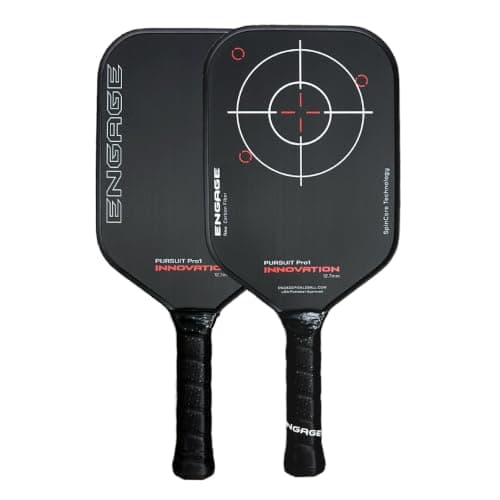
A thin-core, high-dwell spin machine for aggressive players — it grabs the ball like nothing else here, and gives back less margin on resets.
- Best for
- Aggressive spin players with a developed soft game
- Price context
- Upper-mid tier
The last several years of paddle design have moved in one direction: thicker cores, stiffer frames, more foam. The Engage Pursuit Pro1 goes against the current with a 12.7mm core under a raw carbon fiber face in an elongatedshape. That is a deliberate choice with real consequences, and it produces one of the most distinctive paddles you can buy. This is a research-plus-play review; the specifications are verified against Engage's published listing.
Why a thinner core, when everyone went thicker
A thicker core absorbs more impact energy. That is why 16mm became the default: it makes resets and dinks more controllable, which is where most points are decided. The cost is that a highly absorbent paddle also deadens the ball on shots where you want it lively.
A thinner core does the opposite — and, counter-intuitively, it can produce more dwell rather than less. A thin core flexes further at impact, so the face deforms around the ball and stays in contact fractionally longer before releasing it. More contact time means the face texture has more opportunity to bite, which means more spin for the same swing.
The raw carbon face is the other half. "Raw" means unpainted — the texture you feel is the weave itself, which is what actually grips the ball. Paint smooths that texture out. See carbon vs fiberglass for how much the face material changes things.
How it plays on court
Topspin drives.The paddle's reason to exist. Combine a face that grips, a core that holds the ball, and elongated leverage, and a normal swing produces a ball that dips hard inside the baseline. Third-shot drives become genuinely dangerous.
Roll volleys. The other place the dwell shows. Rolling a ball at the kitchen line with topspin is a shot that separates 4.0 from 4.5, and this paddle makes it easier to hit than most.
Serves and returns.Heavy, shaped serves come easily. Returns with slice also bite noticeably — the texture works in both directions.
Resets and blocks.The trade. With less core to absorb pace, a hard-driven ball comes off the face faster than you might want. You compensate with a shorter swing and a looser grip — it works, but it is a skill you supply. If your soft game is still developing, this paddle will expose it.
The spin case, honestly
Spin comes from two inputs: how fast the face is moving across the ball, and how much the face grips. The Pursuit Pro1 optimizes both — elongated length for head speed, raw carbon plus a flexing thin core for grip and contact time. Among paddles I have played, it is at the top of the spin range along with JOOLA's Hyperion CAS 16.
One caveat worth stating: all textured faces wear. The grit that generates spin abrades with use, faster on rough outdoor courts than on gym floors, and a worn face spins measurably less. Cleaning helps and eventually stops helping — our paddle care guide covers what actually restores grit and what just moves dirt around. Budget for the face being a consumable if spin is why you bought the paddle.
Who it's for (and who should skip it)
Buy it if spin is your weapon, you already reset reliably, and you like a lively paddle that rewards a full swing. It gives an aggressive player a bigger toolbox than almost anything at the price.
Skip it ifyou are still learning the soft game, you play mostly at the kitchen line, or you have any elbow history — a thin, lively core transmits more shock than a thick absorbent one. Our control roundup and tennis elbow roundup are the alternatives.
How it compares
| Paddle | Core | Shape | Where it wins |
|---|---|---|---|
| Engage Pursuit Pro1 | 12.7mm | Elongated | Spin and dwell |
| JOOLA Hyperion CAS 16 | 16mm honeycomb | Elongated | Spin with a better soft game |
| Vatic Pro Prism Flash | 16mm, foam walls | Elongated | Balance and value |
| Gearbox GX2 Hyper | SST 2.0 carbon core | Power profile | Flat ball speed |
The closest comparison is the JOOLA Hyperion CAS 16: similar spin ceiling, but the Hyperion's 16mm core gives more margin on resets. Against the Vatic Pro Prism Flash, the Engage spins more and forgives less. And against the Gearbox GX2 Hyper, you are choosing heavy spin over flat pace. Full context in best paddles for spin.
Verdict
The Pursuit Pro1 is a specialist that knows it. The thin core is not a cost-saving or an oversight — it is the mechanism that makes the paddle spin the way it does, and the reason resets ask more of you. If your game is built on shaping the ball, few paddles reward it more directly. If your game is built on absorbing and outlasting, buy a thicker core and be happier. Either way, read 14mm vs 16mmbefore you decide — core thickness is the single spec that will change your results most.
What we liked
- Exceptional spin — the thin core and raw carbon face work together
- Long dwell time makes shaping topspin drives and rolls easier
- Elongated leverage adds head speed for the same swing
- Distinctive, lively feel that rewards a full swing
What gave us pause
- A 12.7mm core absorbs less pace — resets take real technique
- Elongated plus thin core is the least forgiving combination here
- Not a paddle for developing players or sore elbows
Frequently asked questions
Why does the Engage Pursuit Pro1 use a thin 12.7mm core?
It's a deliberate spin choice. A thinner core flexes further at impact, so the face deforms around the ball and stays in contact fractionally longer — more dwell time means the texture has more opportunity to grip and generate spin. The trade is less absorption, which makes resets and blocks harder than they'd be on a 16mm core.
Is a thin-core paddle good for beginners?
No. Thin cores return more of the incoming pace, which makes resets, blocks and dinks noticeably harder — exactly the shots a developing player needs the paddle's help with. A 16mm core is the better learning tool; come back to a thin core once your soft game is reliable.
Does the Pursuit Pro1 spin more than a JOOLA Hyperion?
They're both at the top of the spin range, and which one edges it depends on your swing. The Engage's thin core adds dwell time, while the Hyperion's Carbon Abrasion Surface is one of the grittiest faces available with a more forgiving 16mm core behind it. If you want maximum spin with more reset margin, the Hyperion; if you want maximum grab, the Engage.
Do raw carbon faces wear out?
Yes. The surface texture that generates spin abrades with use — faster on rough outdoor courts — and a worn face spins measurably less. Regular cleaning slows the decline and a carbon-face eraser restores some grit, but eventually the face is a consumable. Factor that into the cost if spin is your reason for buying.
Sources
Keep reading
Upgrading your paddle or gearing up to play?
See how we pick, then dig into the paddle roundups and buying guides — honest picks from someone who actually plays, with no inventory to move.