Paddle Review
Osmo Elite Spin Review
A raw T700 carbon face for less than the cost of a decent overgrip habit. The Osmo Elite Spin is the clearest example yet of how far the budget end of the paddle market has moved - and where it still cannot follow.
The cheapest genuinely raw-carbon paddle worth owning - a real spin face at a price that makes the usual budget compromises easy to forgive.
- Best for
- Improving players who want spin without spending $100
- Price context
- Budget tier
Two years ago, if you wanted a paddle that could genuinely rip topspin, the entry price was around a hundred dollars. The Osmo Elite Spin puts a Toray T700 raw carbon fiber face over a polypropylene honeycomb core for roughly half that. It is worth understanding exactly what that does and does not buy, because the spec sheet reads like a paddle costing three times as much and the paddle is not, in fact, a paddle costing three times as much.
This is a research-plus-play review. The construction claims are taken from Osmo's current listing; the on-court notes draw on time with budget raw-carbon paddles of this construction type, which behave consistently as a class. Where I am generalizing from the category rather than this specific unit, I say so.
What 'T700 raw carbon' actually means
Two separate claims are packed into that phrase, and both matter.
T700is a Toray carbon fiber grade — a specification of the fiber itself, widely used across the paddle industry from budget builds to flagships. It is a real material designation rather than a made-up marketing word, though it says nothing about how well the paddle around it is built.
Rawis the more important word. A raw carbon face is left unpainted and unsealed, so the surface you strike the ball with is the weave itself. That produces a naturally abrasive texture that grips the ball and imparts spin. The alternative — extremely common at this price — is a smooth composite face with a texture printed or sprayed on top, which grips less and wears off much faster. Our carbon fiber vs fiberglass guide explains the mechanism in full.
Why that spec at this price is notable
The budget paddle market has historically had a hard ceiling: below about $60 you got a fiberglass face, a thin core, and no spin worth the name. Everything cheap was a beginner paddle whether you were a beginner or not.
What has changed is manufacturing scale. Raw carbon faces and polypropylene honeycomb cores are now commodity inputs, and small brands can assemble a competent paddle from them without the tooling investment that thermoforming requires. The result is a new tier: paddles that make real spin but are built conventionally. The Osmo sits squarely in it, alongside paddles like those in our best paddles under $75 roundup.
How it plays
The spin is real.That is the headline and it holds up. A raw T700 face grabs the ball on a brushing swing, which means topspin rolls from below net height and dipping drives become shots you can actually attempt. If you have been playing with a smooth-faced beginner paddle, the jump is immediately obvious — it will feel like the ball is sticking to the face.
The core is sensible. A polypropylene honeycomb core is the right choice at this price: softer and more forgiving than the firm cores that cheap paddles often use, which keeps the paddle comfortable and reasonably controlled rather than pingy.
The stability is where you feel the price.This is a conventionally built paddle — no thermoformed unibody, no foam-injected perimeter. So when you catch a ball out toward the edge, the face flexes and the shot loses more speed and direction than it would on a paddle with a stiffened perimeter. That is exactly what the expensive constructions in our best Gen 3 paddles roundup are buying you.
Where the corners were cut
Being straight about a budget paddle means naming what is missing.
Published specs are thin.Osmo lists the face and core but not the detail a major brand publishes — static weight range, grip circumference, core thickness, swing weight. That makes it hard to know what you are getting before it arrives, and it is the single biggest practical drawback.
Grit longevity.Raw carbon grades vary, and cheaper raw faces tend to lose their bite sooner than premium ones. That does not make the paddle bad — it makes it a consumable. At this price, replacing it every year or two is a rational plan, which is genuinely not true of a $250 paddle.
No brand safety net. A small brand means limited warranty support and a thin resale market. If that matters to you, spend up.
Keeping the grit (this one is on you)
A raw carbon face works because of microscopic surface texture, and that texture fills with court dust, ball residue and skin oil. A clogged face does not spin, and most players blame the paddle when the real problem is that it has not been wiped in three months.
A damp microfibre cloth after each session covers 90% of it; a dedicated carbon cleaning block handles the rest. Our paddle care and cleaning guide covers the routine, and it matters more on a budget raw face than on a premium one.
Who it's for (and who should skip it)
Buy it if you are moving up from a starter-set paddle and want to learn what spin feels like without gambling a hundred dollars; if you want a second paddle to keep in the car; or if you are buying for a teenager who will outgrow it anyway.
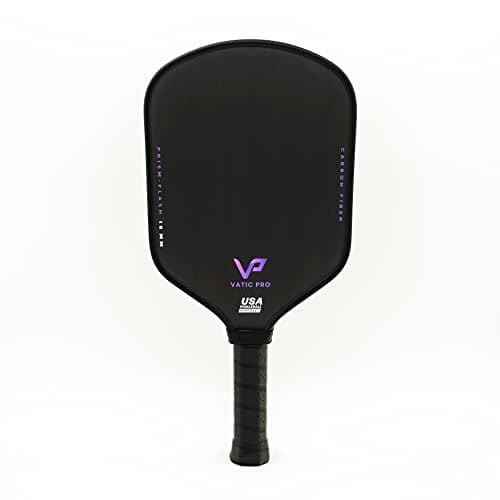
Skip it if you are a 4.0-plus player who needs consistent off-center performance, if you want documented specs before you buy, or if you would rather own one paddle for five years than three paddles in five years. In those cases the Vatic Pro Prism Flash at around $100 is the obvious next rung: same raw carbon idea, thermoformed construction, foam walls, published specs.
Verdict
The Osmo Elite Spin is proof that the floor has moved. A genuine raw T700 face on a polypropylene core, at a price where the market used to offer nothing but smooth fiberglass, is a real thing to celebrate — and the spin it produces is not a marketing claim, it is the reason to buy it. What you do not get is stability under imperfect contact, published specifications, or a face that will still bite in three years. At this price, all three are reasonable things to trade away. It is the paddle I would recommend to someone leaving a starter set behind and not ready to spend real money yet.
What we liked
- A genuine T700 raw carbon face, not a printed texture over paint
- Real, usable spin at a price where spin usually is not on the menu
- Polypropylene core rather than the cheap firm cores common at this price
- Low enough cost that replacing it when the grit wears is not painful
What gave us pause
- Small brand with thin published specs and limited track record
- Budget raw carbon loses its grit faster than premium grades
- No thermoforming or foam walls, so off-center contact is less stable
Frequently asked questions
Is the Osmo Elite Spin a good pickleball paddle?
For its price, yes. It puts a genuine T700 raw carbon face over a polypropylene honeycomb core for under sixty dollars, which produces real, usable spin at a price point that used to offer only smooth fiberglass. What it does not offer is the off-center stability of a thermoformed paddle, detailed published specifications, or long-term grit durability.
What does T700 raw carbon mean on a paddle?
T700 is a Toray carbon fiber grade used widely across the paddle industry — a real material specification, though it says nothing about the quality of the paddle built around it. 'Raw' is the more meaningful word: it means the face is left unpainted and unsealed, so you strike the ball with the weave itself. That naturally abrasive surface is what creates spin, as opposed to a texture printed over a glossy finish, which grips less and wears off.
How long does the grit last on a cheap raw carbon paddle?
Less time than on a premium one, and much less time if you never clean it. Raw carbon faces work through microscopic texture, and that texture fills with court dust, ball residue and skin oil — a clogged face stops gripping long before it is genuinely worn out. A wipe with a damp microfibre cloth after each session restores most of the bite. Treat a budget raw-carbon paddle as a consumable you replace every year or two.
Is the Osmo Elite Spin good for beginners?
It is a good second paddle for someone leaving a starter set, but not necessarily a first one. Raw carbon rewards a brushing swing that a brand-new player has not developed yet, and a conventionally built paddle is less forgiving on off-center contact than a wide, thick-cored beginner paddle. If you have been playing a few months and want to learn spin, this is a sensible and cheap way to do it.
Osmo Elite Spin or a $100 paddle?
The $100 tier buys you construction rather than a better face — thermoforming, foam-injected perimeter walls, and published specifications, all of which make off-center contact more predictable. If you are a 4.0-plus player whose mis-hits cost you points, that is worth paying for and the Vatic Pro Prism Flash is the obvious step up. If you are improving and mostly want to feel what spin does, the Osmo delivers the important half for a third of the money.
Sources
Keep reading
Upgrading your paddle or gearing up to play?
See how we pick, then dig into the paddle roundups and buying guides — honest picks from someone who actually plays, with no inventory to move.