Buying Guide
How Much Does a Pickleball Paddle Cost?
Paddles run from about $20 to about $300, and the amount of paddle you get per dollar is wildly uneven across that range. Here is exactly what each price band buys, and where the curve flattens out.
A pickleball paddle costs between about $20 and $300. That range is not useful on its own, because the relationship between price and quality is not linear — the jump from $30 to $100 changes almost everything about how a paddle plays, and the jump from $150 to $300 changes remarkably little for most players.
This page maps the bands honestly, including the part most buying guides skip: the point at which spending more stops buying you anything you will notice.
The short answer
Most people should spend between $70 and $120.That band buys a raw or textured carbon face, a proper 16mm polymer core, and in many cases thermoformed construction — which is essentially everything that determines how a paddle plays. Below it you give up spin; above it you are buying refinement.
If you are brand new and unsure you will stick with the sport, $40–$60 is a completely sensible place to start. If you compete, $150–$300 buys real advantages at the margins. Almost nobody needs to spend more than $300, and nobody at all needs to spend $300 as a first paddle.
The price bands, explained
| Band | What you get | Who it is for |
|---|---|---|
| $20-40 | Fiberglass face, thin polymer or basic core, often sold as a 2-paddle set | Complete beginners; loaners; deciding whether you like the sport |
| $40-75 | Textured or raw carbon face appears; proper 16mm polymer cores; USA Pickleball approval standard | Improving recreational players; the value sweet spot begins |
| $75-130 | Raw carbon faces, thermoformed unibody construction, foam-injected walls, published specs | The band most players should buy in |
| $130-200 | Premium core tunings, better torsional stability, brand support, shape ranges | Committed players; league and club competitors |
| $200-300 | Flagship materials, foam cores, dual certifications, verification chips | Tournament players whose margins are thin |
The most important line in that table is the second one. Somewhere around $45–$50, raw carbon faces started appearing — and a raw carbon face is what produces spin. That single change is the biggest performance jump available at any price, and it now happens far lower down the range than it did two years ago. Our best paddles under $75 roundup covers that band in detail.
What your money actually buys
Four things, in roughly the order they matter.
1. The face material (the biggest single jump). A smooth fiberglass face makes almost no spin. A raw, unpainted carbon face grips the ball and makes topspin a shot you can actually attempt. Everything else on this list is a refinement compared with that change. See carbon fiber vs fiberglass.
2. Core thickness and quality.Moving from a thin, hard budget core to a proper 16mm polymer honeycomb transforms control, comfort and forgiveness. This typically happens around $50–$70. See 14mm vs 16mm.
3. Construction method.Thermoformed unibody builds and foam-injected perimeters stiffen the paddle so off-center contact keeps more of its speed and direction. This starts around $90–$100 and is what most of the $100–$200 band is buying. See thermoformed vs cold-pressed.
4. Everything else. Torsional stability, face-grit longevity, quality control, shape options, warranty depth, certifications and verification chips. Real, valuable to competitive players, and largely invisible below about 4.0.
Where the curve flattens
Being straight about this is the whole point of the page. The performance-per-dollar curve rises steeply to about $100, keeps rising gently to about $150, and then flattens hard.
Between $150 and $300 you are buying margins: a face that keeps its grit through a tournament weekend rather than a season, a head that twists a few degrees less on an edge hit, a core tuned a little more precisely. Those things decide points at 4.5-plus. Below that, they are invisible — and a $250 paddle in the hands of a 3.5 player will not beat a $100 paddle in the same hands.
The honest corollary: if you have $250 to spend on pickleball, a $100 paddle plus a good pair of court shoes will do more for your results, and considerably more for your ankles, than a $250 paddle and running shoes.
Cost per year, not cost per paddle
The right way to think about paddle spend is annual, not one-off, because textured faces are consumables. A raw carbon face works through microscopic surface grit that fills with court dust and wears smooth with play. Premium grades hold their bite longer than budget ones, but none of them last forever, and a face that has gone smooth has lost the reason you bought it.
That changes the math. A $90 paddle replaced every two years and a $250 paddle replaced every four cost roughly the same per year — except the $90 route means you are playing with a fresher face more of the time, and you get to re-choose as your game changes. Cleaning extends any face's working life substantially; our paddle care guide covers the routine.
The paddle to buy at three budgets
One recommendation per band, chosen as the clearest example of what that money buys.
Under $50 — Osmo Elite Spin. A genuine T700 raw carbon face at a price that used to buy smooth fiberglass. It is the cheapest paddle on this site that can actually produce spin, and it is the right answer for someone leaving a starter set behind.
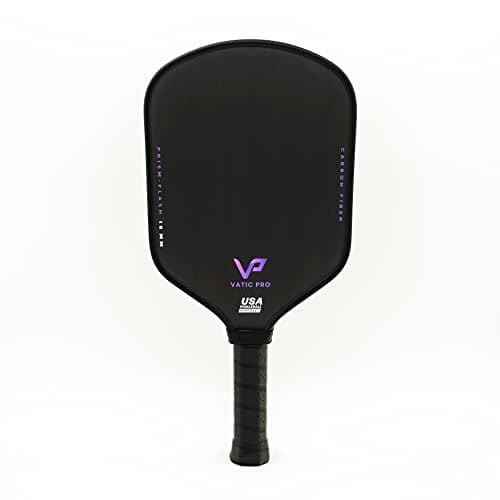
Around $100 — Vatic Pro Prism Flash 16mm.Raw carbon, thermoformed unibody, foam-injected walls, cover included. This is the paddle that demonstrates why the $75–$130 band is where most people should shop.
Premium — JOOLA Perseus 16mm CAS. A high-grit carbon abrasion surface on an elongated flagship shape. If you compete and want to feel what the top of the range offers, this is a genuine flagship rather than a price-anchored one.
The bottom line
Spend $70–$120 if you play regularly and want one paddle that does not hold you back. Spend $40–$60 if you are new and still deciding. Spend more than $150 only if you compete and can name the specific thing you want that your current paddle does not do. And whatever you spend, spend $50 on court shoes first — it is the only pickleball purchase with an injury argument behind it.
Ready to choose? Start with how to choose a pickleball paddle, then the band that fits: under $75, under $100, under $200, or the advanced roundup at the top end. If you are weighing brand names rather than price bands, our best pickleball paddle brands page covers what each one is actually good at.
If fifty dollars is the ceiling, best pickleball paddles under $50 covers what that now buys, and do pickleball paddles make a difference answers whether spending more would change your game at all.
Frequently asked questions
How much should I spend on a pickleball paddle?
For most regular players, $70 to $120. That band buys a raw or textured carbon face, a proper 16mm polymer core and often thermoformed construction — essentially everything that determines how a paddle plays. If you are brand new and still deciding whether you will stick with the sport, $40 to $60 is entirely sensible. Above about $150 you are buying margins that matter mainly to competitive players.
Are expensive pickleball paddles worth it?
At 4.5 and above, often yes: face-grit longevity, torsional stability and precise core tuning decide points at that level. Below about 4.0, the difference between a $100 paddle and a $250 one is largely invisible in results. The performance-per-dollar curve rises steeply to around $100, gently to $150, and then flattens hard.
Why are some pickleball paddles $300?
Flagship materials and construction — full foam or premium tuned cores, top-grade raw carbon faces that hold their grit longer, dual USA Pickleball and UPA-A certifications, verification chips against counterfeits, and tight quality control. Some of the price is also pro sponsorship, retail presence and marketing, which is why direct-to-consumer brands sell similar construction for a third as much.
How often do you need to replace a pickleball paddle?
Judge by the face rather than the calendar. Textured carbon faces are consumables — the microscopic grit that produces spin fills with dust and wears smooth with play, and a smooth face has lost the reason you bought it. Regular cleaning extends that considerably. A frequent player might replace a budget carbon paddle every year or two and a premium one somewhat less often.
What's the cheapest decent pickleball paddle?
Around $45 to $50 now buys a genuine raw T700 carbon face, which is the single biggest performance jump available at any price — it is the difference between a paddle that can spin the ball and one that cannot. Below about $40 you are mostly buying smooth fiberglass paddles that work fine for learning but will limit you as soon as you develop a swing.
Sources
Keep reading
Upgrading your paddle or gearing up to play?
See how we pick, then dig into the paddle roundups and buying guides — honest picks from someone who actually plays, with no inventory to move.