Buying Guide
How Much Does a Pickleball Weigh?
The official answer is a range, not a number - and where a ball sits inside that range changes how it plays. The full legal specification, and why indoor and outdoor balls feel so different.
The short answer
A pickleball weighs between 0.78 and 0.935 ounces — that is 22.1 to 26.5 grams — under the USA Pickleball rulebook. There is no single legal weight; every approved ball has to fall inside that band, and manufacturers deliberately place their balls at different points within it.
For comparison: a pickleball is roughly a third the weight of a tennis ball and a little lighter than a golf ball. A pickleball paddle is a completely different question and has no weight limit at all in the rules, though almost every paddle sold weighs between about 7.2 and 8.5 ounces.
If you came here because you are choosing a ball rather than settling a bet, the short version is that outdoor balls sit near the heavy end of the range with small hard holes, and indoor balls sit lighter and softer with larger holes — and that difference matters far more in play than the raw gram figure. Our indoor vs outdoor balls guide covers the choice itself.
The full legal specification
Weight is only one of six properties a ball has to satisfy to be approved. Here is the complete set, from the USA Pickleball rulebook equipment section.
| Weight | 0.78 to 0.935 oz (22.1 to 26.5 g) |
|---|---|
| Diameter | 2.874 to 2.972 in |
| Holes | 26 to 40 circular holes |
| Bounce | 30 to 34 in, dropped from 78 in onto granite |
| Hardness | 40 to 50 on the Durometer D scale at 75-80 F |
| Out-of-round variance | No more than 0.020 in |
A few things worth noticing. The hole count is a range, not a number, which is why outdoor balls with 40 small holes and indoor balls with around 26 larger ones are both legal. The bounce test is standardized onto granite at a controlled temperature, which is why real-world bounce on a cold morning or a hot afternoon differs from the printed figure. And the hardness band is narrow— it is the main reason outdoor balls crack in cold weather, because a hard plastic at 50 Durometer has very little give left when the temperature drops.
Why the range matters
The gap between the lightest and heaviest legal pickleball is about 20% of the ball's weight, which is a lot. Manufacturers use that latitude deliberately, and it produces three effects you can feel.
Heavier balls cut through wind. A ball at the top of the range holds its line in a breeze far better than one at the bottom. This is why serious outdoor balls are heavy, and why playing an indoor ball outdoors on a windy day is an exercise in frustration.
Lighter balls are easier to control and slower. Less mass means less energy at the same racquet speed, which is why indoor balls feel softer off the face and why they suit a soft game and a gym floor.
Heavier balls are harder on your arm. More mass arriving at the paddle means more shock up the handle. If you have tennis elbow or arthritic hands, a lighter indoor ball is a real and free intervention.
One number manufacturers rarely publish is where their ball sits in the band, which is genuinely annoying. The exception on this page is the Gamma Librarian foam ball, which publishes 0.847 oz and a 2.91 in diameter — comfortably mid-range on weight.
Indoor vs outdoor weight
| Property | Outdoor ball | Indoor ball |
|---|---|---|
| Position in the weight band | Upper half | Lower half |
| Holes | 40, small | About 26, larger |
| Plastic | Harder, more brittle | Softer, more flexible |
| Wind behavior | Holds its line | Pushed around badly |
| Feel off the paddle | Firm, fast, loud | Soft, slower, quieter |
| Failure mode | Cracks, especially in cold | Goes soft and out of round |
| Typical lifespan | A few sessions of hard play | Longer, but deforms |
Both types sit inside the same legal weight band — an outdoor ball is not illegally heavy, it is just placed near the top of the permitted range. The hole size and plastic hardness do as much work as the weight does, and together they are why the two balls feel like different sports.
How much does a paddle weigh?
This is the question most people actually mean, and the answer is different in kind: the rules do not limit paddle weight at all. What they limit is size.
| Weight limit | None in the rules |
|---|---|
| Typical sold weight | About 7.2 to 8.5 oz |
| Length limit | 17 in maximum |
| Combined length + width | 24 in maximum |
| Thickness limit | None in the rules |
In practice the market has settled into three bands: lightweight under about 7.8 oz, midweight from roughly 7.8 to 8.2 oz, and heavyweight above about 8.3 oz. Lighter paddles move faster and load your arm less; heavier ones hit harder and absorb pace better. Which band suits you is a real decision with real consequences, and it has its own full guide: pickleball paddle weight.
Because there is no weight limit, players legally add weight with lead tapeto change swing weight and balance — a common and entirely permitted modification.
Balls worth buying
Four balls that cover the realistic cases. All four are approved or purpose-built, and all four are on our fuller best pickleball balls and best practice balls roundups.
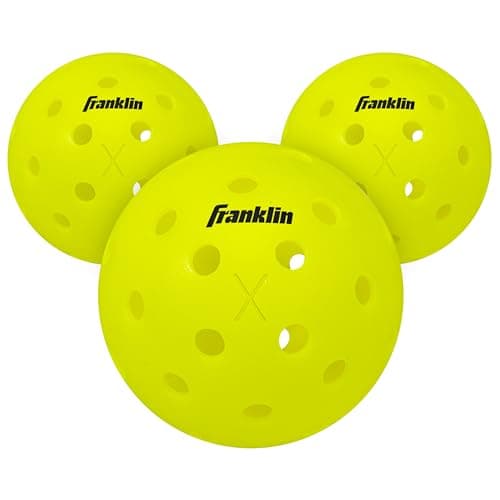
Franklin X-40 Outdoor— who it is for: anyone playing outdoors who wants the default. It is the official ball of USA Pickleball, the APP Tour and the US Open, with the standard 40-hole outdoor pattern, and it is the cheapest ball on this page. If you are not sure what to buy, buy this.
| Type | Outdoor |
|---|---|
| Holes | 40 (outdoor pattern) |
| Certification | USA Pickleball approved |
| Notable | Official ball of USA Pickleball, APP Tour, US Open |
| Best for | The universal outdoor default |
Dura Fast 40— who it is for: competitive outdoor players. The long-standing tournament standard: fast, lively and consistent, with the same 40-hole pattern. The known weakness is cold — the hard plastic that makes it fast also makes it crack in low temperatures, which is a direct consequence of sitting near the top of the legal hardness band.
| Type | Outdoor |
|---|---|
| Holes | 40 (outdoor pattern) |
| Character | Fast, lively, tournament standard |
| Note | Can crack in cold weather |
| Best for | Competitive outdoor play |
Gamma Photon Indoor— who it is for: gym-floor and sport-tile play. About 26 larger holes, softer plastic, high-visibility and ultra-balanced. It sits lower in the weight band than either outdoor ball, which is why it feels so much easier to control — and why it is also the kinder ball on a sore elbow.
| Type | Indoor |
|---|---|
| Holes | About 26 (larger indoor holes) |
| Feel | Softer, quieter, easy to control |
| Visibility | High-visibility, ultra-balanced |
| Best for | Indoor and gym-floor play |
Gamma Librarian Foam— who it is for: noise-restricted courts and anyone who wants published numbers. This is the one ball here whose maker states its figures: 2.91 in diameter and 0.847 oz, which is mid-range on weight despite being a foam ball. Gamma puts it at about 60 dB, roughly conversation level, and it is listed on the USA Pickleball Quiet Category acoustic equipment list. Owners do report a higher bounce than a regulation ball, so it is a practice and quiet-play ball rather than a game ball.
| Type | Foam quiet ball |
|---|---|
| Diameter | 2.91 in (Gamma published) |
| Weight | 0.847 oz (Gamma published) |
| Noise | About 60 dB per Gamma - roughly conversation level |
| Listed by | USA Pickleball Quiet Category acoustic equipment list |
| Watch out | Owners report a higher bounce than a regulation ball |
The bottom line
A pickleball weighs 0.78 to 0.935 oz (22.1 to 26.5 g), is 2.874 to 2.972 in across, and has 26 to 40 holes. Outdoor balls sit near the heavy, hard end of those ranges and indoor balls near the light, soft end, and that placement — not the raw number — is what you actually feel. Paddles have no weight limit at all, only a 17 in length and 24 in combined-dimension cap, though nearly everything sold lands between 7.2 and 8.5 oz.
Frequently asked questions
How much does a pickleball weigh in grams?
Between 22.1 and 26.5 grams, which is 0.78 to 0.935 ounces, under the USA Pickleball rulebook. There is no single legal weight - every approved ball must fall inside that band, and manufacturers place their balls at different points in it deliberately. Outdoor balls sit in the upper half of the range, indoor balls in the lower half.
How much does a pickleball paddle weigh?
The rules set no weight limit on paddles at all - only a maximum length of 17 inches and a maximum combined length plus width of 24 inches. In practice almost every paddle sold weighs between about 7.2 and 8.5 ounces, grouped into lightweight (under 7.8 oz), midweight (7.8 to 8.2 oz) and heavyweight (above 8.3 oz) bands.
How big is a pickleball?
Between 2.874 and 2.972 inches in diameter, with an out-of-round variance of no more than 0.020 inches. That makes it slightly smaller than a tennis ball and noticeably larger than a golf ball. It must also have between 26 and 40 circular holes - outdoor balls typically use 40 small ones and indoor balls about 26 larger ones.
Are indoor pickleballs lighter than outdoor ones?
Yes, as a rule - both are legal, but indoor balls are placed in the lower half of the permitted weight band and outdoor balls in the upper half. Combined with softer plastic and larger holes, that is why indoor balls feel slower, quieter and easier to control, and why they get pushed around badly if you take them outside on a windy day.
How high should a pickleball bounce?
Between 30 and 34 inches when dropped from a height of 78 inches onto a granite surface, which is the standardized test in the USA Pickleball rulebook. Real-world bounce varies from that figure because the test is run at a controlled temperature - a cold ball on a cold court bounces lower, and a hot ball on a hot court bounces higher.
Does pickleball weight affect how hard it hits your arm?
Yes. More mass arriving at the paddle means more shock transmitted up the handle, so a heavier outdoor ball loads the arm more than a lighter indoor one. If you are dealing with tennis elbow or sore hands, switching to indoor play with a lighter, softer ball is a genuine and free intervention - often more effective than changing paddles.
Sources
Keep reading
Upgrading your paddle or gearing up to play?
See how we pick, then dig into the paddle roundups and buying guides — honest picks from someone who actually plays, with no inventory to move.