Reference Guide
Pickleball Court Dimensions
Every measurement you need, from the official court to the driveway version — plus the space requirement nobody accounts for until they've painted the lines.
A pickleball court is small, and its dimensions are the reason the sport plays the way it does. Understanding where the lines are — especially the kitchen line — is worth more than it sounds, because most of the strategy in the game is about which side of a line you and the ball are on.
These are the official measurements from USA Pickleball's rules, followed by what they mean if you're laying one out at home.
The numbers
| Measurement | Size |
|---|---|
| Court, total playing area | 20 ft wide × 44 ft long |
| Non-volley zone (kitchen), each side | 7 ft from the net, full 20 ft width |
| Service court, each | 10 ft wide × 15 ft long |
| Net height at the sidelines | 36 in |
| Net height at the center | 34 in |
| Line width | 2 in |
| Recommended total space | 30 ft × 60 ft minimum |
| Preferred tournament space | 34 ft × 64 ft |
Lines are 2 inches wide and are part of the court.A ball touching any line is in — with one exception. On a serve, a ball touching the non-volley zone line is a fault, because the serve must clear the kitchen entirely.
How the court divides up
Each half of the court is 22 feet deep, and it splits into two regions:
The non-volley zone (kitchen).The 7 feet nearest the net, running the full 20-foot width. Neither player may volley the ball while standing in it or touching its lines. This is the rule the entire game is built around — see what is the kitchen in pickleball.
The service courts. The remaining 15 feet on each side, split down the middle by the center line into two service courts of 10 feet wide by 15 feet long each. Serves are hit diagonally into the opposite one, and they must land beyond the kitchen line.
Add those up per side: 7 feet of kitchen plus 15 feet of service court equals 22 feet, and two halves make the 44-foot total.
The right-hand service court as you face the net is the even court, and the left is the oddcourt — you serve from the even side when your team's score is even. Our pickleball rules guide covers how that drives the scoring.
The net
The net is 36 inches high at the sidelines and 34 inches at the center. That two-inch sag is deliberate, not slack — it's written into the rules, and it's the reason a cross-court dink is safer than a straight-ahead one: you're hitting over the lowest part of the net across the longest diagonal of the court.
Net posts sit 22 feet apart, one foot outside each sideline, so the net spans the full width of the court and a little beyond.
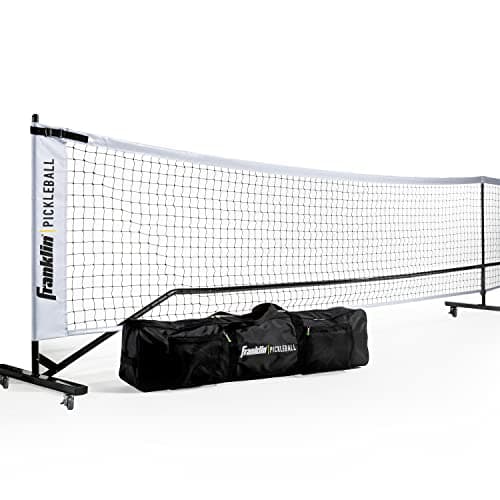
If you're buying a portable net, this is the specification that separates a real one from a toy. Nets that sag below 34 inches at the center change every shot you practice — you learn to clear a height that doesn't exist on a proper court. Look for a center support strap. Our best portable pickleball nets roundup covers which ones hold their height.
Total space you actually need
This is the measurement people forget. The court is 20 by 44 feet, but you cannot play in exactly 20 by 44 feet — balls go past the baseline and you have to run for them.
USA Pickleball recommends a minimum total playing area of 30 by 60 feet and prefers 34 by 64 feet for tournament play. That is roughly 5 feet of side run-off and 8 feet behind each baseline at the minimum.
For a home court, be realistic about what you have.Many households play on a 20 by 44 court with minimal run-off and it works fine for casual games. What matters most is that whatever is at the edge of the space is safe to run into — a fence at the baseline is very different from a garage door.
Compared with a tennis court
| Pickleball | Tennis (doubles) | |
|---|---|---|
| Court size | 20 × 44 ft | 36 × 78 ft |
| Net height at center | 34 in | 36 in |
| Net height at posts | 36 in | 42 in |
| Same court for singles? | Yes | No — narrower singles court |
A pickleball court is roughly a quarter the area of a tennis court, which is why up to four pickleball courts fit inside one tennis court— the conversion that has driven much of the sport's growth at clubs and parks.
The net is also lower, which changes everything about how the ball must be hit. Tennis converts often struggle initially because their instinct is to drive through balls that a lower net and shorter court will punish — our best paddles for tennis players roundup covers the equipment side of that transition.
Laying out a home court
Measure the space first, honestly.A standard two-car driveway is often close to 20 feet wide, which is why driveway pickleball works — length is usually the binding constraint.
Mark the four corners, then the kitchen lines.Get the outer rectangle right first (20 × 44), check the diagonals match so it's square, then measure 7 feet in from the net line on each side for the kitchen, and run the center line from the kitchen line to the baseline.
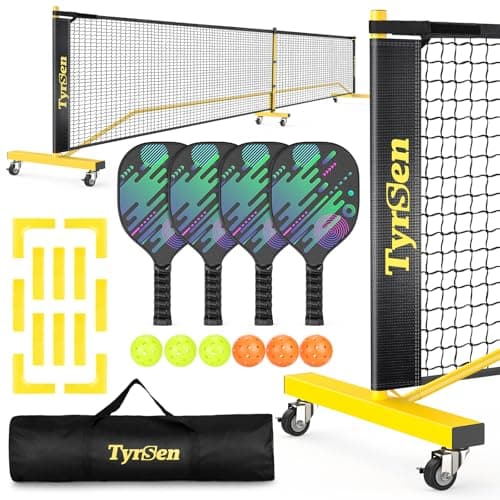
Court markers or tape beat paint.Removable court marker sets and gaffer tape work well and don't commit your driveway permanently. Several complete sets with a net include court markers for exactly this.
If you don't have the length, play half-court.Set the net up and play kitchen-line dinking games in whatever depth you have. That is the shot that decides most points anyway, and it makes a 20-foot driveway genuinely useful — the drills in our dinking drills guide are designed for exactly this.
Surfaces
Outdoor hard courts— concrete or asphalt, usually with an acrylic surface coating — are the most common. They're abrasive, which is hard on shoes and balls. Use outdoor balls and a court shoe with a durable outdoor outsole.
Indoor wood or sport-court surfacesare faster underfoot and gentler on equipment. They need non-marking gum-soled shoes and indoor balls — indoor vs outdoor balls explains why the ball matters as much as the shoe.
Driveways and garage floorsvary enormously. Watch for slope, which you'll never notice walking and will notice immediately when the ball rolls, and for cracks that turn a predictable bounce into a coin flip.
One court you cannot improvise: a padel court is 20 by 66 feet and enclosed by glass and mesh walls that are part of the game, which makes it a different sport despite the similar name — padel vs pickleball sets the two side by side.
Frequently asked questions
What are the dimensions of a pickleball court?
A pickleball court is 20 feet wide by 44 feet long, including the lines, and the dimensions are identical for singles and doubles. Each side has a 7-foot non-volley zone (the kitchen) extending from the net across the full width, and the remaining 15 feet per side splits into two service courts of 10 by 15 feet.
How high is a pickleball net?
36 inches at the sidelines and 34 inches at the center. The two-inch difference is written into the rules rather than being slack, and it's why cross-court dinks are safer than straight-ahead ones — you're hitting over the lowest part of the net across the court's longest diagonal. Net posts sit 22 feet apart, a foot outside each sideline.
How much space do you need for a pickleball court?
The court itself is 20 by 44 feet, but USA Pickleball recommends a minimum total playing area of 30 by 60 feet and prefers 34 by 64 feet for tournaments, to allow run-off behind the baselines and beside the sidelines. Home courts often work fine with less, provided whatever's at the edge of the space is safe to run into.
How big is the kitchen in pickleball?
The non-volley zone extends 7 feet from the net on each side and spans the full 20-foot width of the court. Its lines are part of the zone, so touching them counts as being in it. The rule attached is simple: you may not volley the ball while standing in the zone or on its lines.
How many pickleball courts fit on a tennis court?
Up to four. A tennis court is 36 by 78 feet for doubles, roughly four times the area of a 20 by 44 foot pickleball court, which is why converting tennis courts has driven so much of the sport's growth at clubs and parks. Many venues instead overlay a single pickleball court within a tennis court using different-colored lines.
Sources
Keep reading
Upgrading your paddle or gearing up to play?
See how we pick, then dig into the paddle roundups and buying guides — honest picks from someone who actually plays, with no inventory to move.