Comparison Guide
Padel vs Pickleball: What's Actually Different?
They are both doubles racket sports played on a small court with a solid bat, they both exploded in the same decade, and they have almost nothing else in common. Here is the honest comparison, including the gear.
Padel and pickleball get compared constantly, mostly by people who have played neither. Both are doubles-first racket sports, both use a solid stringless bat, both are played on courts far smaller than a tennis court, and both grew faster in the last decade than any other racket sport.
The similarities end roughly there. Padel is a walled game descended from squash and tennis, with a bouncing pressurized ball and long, athletic rallies. Pickleball is an open-court game with a hard plastic ball, a non-volley zone, and a soft game that rewards patience over power. If you are trying to work out which to take up — or you are a pickleball player being told you should switch — these are the differences that actually matter.
The short answer
| Pickleball | Padel | |
|---|---|---|
| Court | 20 x 44 ft, open, no walls | 20 x 66 ft, enclosed by glass and mesh walls |
| Walls in play | No | Yes — the ball plays off them |
| Bat | Solid paddle, ~8 oz, no strings | Solid perforated racket, thicker, no strings |
| Ball | Hard perforated plastic | Pressurized felt ball, similar to a tennis ball |
| Serve | Underhand, below the waist | Underhand, after a bounce |
| Signature rule | The non-volley zone (kitchen) | Playing the ball off the back glass |
| Scoring | Side-out or rally to 11 | Tennis scoring: 15, 30, 40, games, sets |
| Physical demand | Moderate; very accessible | Higher; more running and overhead work |
| Where to play | Very widely available, often free | Requires a purpose-built enclosed court |
The court is the whole difference
Almost everything that separates these sports comes from one fact: padel courts have walls, and pickleball courts do not.
A padel court is enclosed by glass and mesh, and the ball stays in play off them. That single rule changes the shape of every rally: a shot that would be a winner in tennis or pickleball comes off the back glass and gets returned, so rallies run long, defense is rewarded, and much of the skill is in reading rebounds. Padel players describe the learning curve as mostly about learning the walls.
Pickleball's equivalent structural rule is the non-volley zone— the seven feet either side of the net where you may not volley. It exists to stop the game becoming a smash-fest at the net, and it is what creates the soft game: dinks, drops, and patient exchanges at the kitchen line. Our what is the kitchen guide covers it, and court dimensions has the measurements.
The practical consequence: a padel court has to be built, at real expense, and there are far fewer of them. A pickleball court is lines on any hard surface plus a net, which is why the sport has spread so quickly — you can play in a driveway with a portable net.
Equipment: paddle vs racket
Both use a stringless solid bat, which is where the confusion starts. They are not interchangeable and you cannot use one for the other.
A padel racketis thick — up to 38mm — with a perforated face, a foam core (EVA or polyethylene) and a wrist strap that is compulsory in play. It is heavier than a pickleball paddle, typically 340–390g (roughly 12–14 oz), and shapes are described as round, teardrop or diamond according to where the balance point sits.
A pickleball paddleis thin — typically 13 to 16mm — with a solid unperforated face, a honeycomb or foam core, and no strap. It is much lighter, usually 7.3 to 8.5 oz, and it is regulated on surface roughness rather than on thickness. Our how to choose a pickleball paddleguide covers the spec decisions, and if you arrived here searching for a "pickleball racket", our best pickleball rackets roundup is the ranked list of what that word actually buys you.
The ball
A padel ball is essentially a slightly less pressurized tennis ball: felt covered, rubber cored, and it bounces high and lively. Rallies feel like tennis rallies.
A pickleballis a hard perforated plastic ball with 26 to 40 holes depending on whether it is an indoor or outdoor design. It does not bounce much, it slows quickly, and it is dramatically affected by wind. That low bounce is the technical reason pickleball's soft game works — a ball that dies quickly can be dropped into the kitchen and kept unattackable. Our indoor vs outdoor balls guide covers the two designs.
Rules and scoring
Padel uses tennis scoring— 15, 30, 40, deuce, games and sets. If you have played tennis, you already know how a padel match is scored.
Pickleball uses its own system, usually games to 11 win by 2, in traditional side-out scoring where only the serving team can score. The call is three numbers — your score, their score, and which server you are — which is the single most confusing thing for newcomers and is explained in our pickleball rules guide.
Both serve underhand, which is unusual among racket sports and one of the genuine similarities. Padel's serve must bounce before you strike it; pickleball's must be struck below the waist with an upward motion. Pickleball also has the two-bounce rule — serve and return must both bounce — which creates the whole third-shot problem described in our third shot drop guide. Padel has no equivalent.
Cost and access
This is the practical difference that decides it for most people.
Padel requires a padel court. Glass walls, mesh, and a purpose-built surface, which means a facility, a booking and a court fee. In most of the US, finding a court at all is the first obstacle. Rackets typically start around $80 and premium ones run to $400.
Pickleball requires a net and a flat surface. Public courts are widespread and usually free, tennis courts are frequently lined for it, and a complete starter set with paddles, balls and sometimes a net costs less than a single padel racket. That accessibility, more than any quality of the game itself, is why pickleball grew the way it did.
Which one will suit you
Choose padel if you come from tennis and want something that feels familiar, you enjoy long athletic rallies, you like the tactical puzzle of playing off walls, and you have a court within a reasonable distance. It is the more physically demanding of the two and the more spectacular to watch.
Choose pickleball if you want to start playing this week, you want a game you can play into your seventies, you like a sport where placement and patience beat power, or you simply want somewhere to play that does not require a booking. It is easier to reach a satisfying standard in, and considerably cheaper to sustain.
And you do not have to choose. The soft hands, the volley positioning and the doubles communication all transfer between them — players who do both generally say each one makes them better at the other.
Starting pickleball
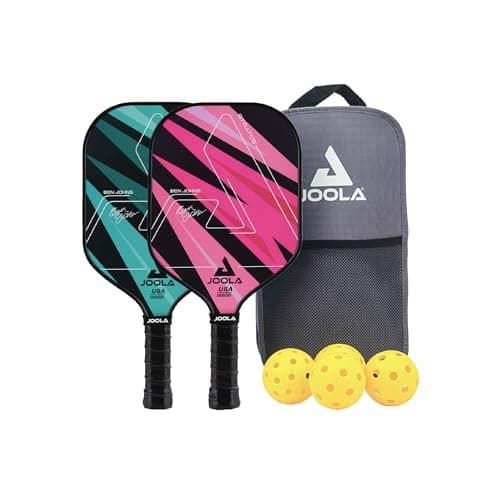
If this comparison has pointed you toward pickleball, the entry cost is genuinely small. A starter set gets two people playing immediately, and a pair of court shoes is the only other purchase that actually matters — running shoes are the leading footwear cause of pickleball ankle injuries, which our what shoes not to wear page explains.
More options in our best pickleball starter sets and best budget pickleball shoes roundups, and pickleball gear for beginners covers what you need in what order.
Frequently asked questions
What's the difference between padel and pickleball?
The court. Padel is played on an enclosed court with glass and mesh walls that the ball plays off, using a pressurized felt ball and tennis scoring — rallies are long and athletic. Pickleball is played on an open court with a hard perforated plastic ball and a non-volley zone at the net, which creates a soft game built on dinks and drops. The equipment differs to match: padel rackets are thick and heavy, pickleball paddles are thin and light.
Can you use a pickleball paddle for padel?
No. A padel racket is much thicker, up to 38mm, with a perforated face, a foam core and a compulsory wrist strap, and it weighs roughly 12 to 14 oz. A pickleball paddle is 13 to 16mm with a solid unperforated face and weighs 7.3 to 8.5 oz. A pickleball paddle is far too light to handle a pressurized padel ball coming off the glass, and it is not legal for padel play.
Is padel harder than pickleball?
Padel has the steeper learning curve, mainly because you have to learn to read balls off the glass, and it is more physically demanding — longer rallies, more running and more overhead work. Pickleball is easier to reach a satisfying standard in and far more accessible to older or less mobile players, which is a large part of why it has grown faster.
Which is more popular, padel or pickleball?
It depends entirely on where you are. Pickleball dominates in the United States, largely because a court is just lines and a net on any hard surface, so public courts are widespread and usually free. Padel is far more established in Spain, Latin America and parts of Europe and the Middle East, where purpose-built enclosed courts are common.
Is padel or pickleball cheaper to play?
Pickleball, by a wide margin. It needs only a flat surface and a net, public courts are common and usually free, and a complete starter set with paddles and balls costs less than a single padel racket. Padel requires a purpose-built enclosed court, which means a facility, a booking and a court fee every time you play.
Sources
Keep reading
Upgrading your paddle or gearing up to play?
See how we pick, then dig into the paddle roundups and buying guides — honest picks from someone who actually plays, with no inventory to move.