How-To Guide
How to Set Up a Portable Pickleball Net
A portable net goes up in about five minutes once you know the order. Get the order wrong and you spend twenty fighting a sagging center strap - which is the single most common complaint about every net ever sold.
The dimensions you are aiming for
Before anything else, know the target. A pickleball net is 36 inches high at the posts and 34 inches high at the center, spanning 22 feet— the full width of the court. The two-inch drop in the middle is deliberate and specified, not a manufacturing compromise.
That is the detail most driveway setups get wrong. People assemble the net, eyeball the middle, and end up playing on a center height of 31 or 32 inches, which quietly makes every dink and drop easier than it should be — so your soft game looks better at home than it does at the club. Measure it with a tape. Full court dimensions, including the kitchen and service boxes, are in our pickleball court dimensions guide.
Setting it up, step by step
1. Pick and clear the spot. The flattest ground you can find, with grit and stones brushed away from where the feet sit. A net on a slope reads the wrong height at one post no matter how carefully you assemble it, and a foot resting on a stone rocks all session.
2. Assemble the frame flat on the ground. Build both uprights and the horizontal top rail while everything is lying down. Push or screw every joint fully home. A joint that is nearly seated is the usual hidden cause of a net that sags half an hour later.
3. Attach the net to the frame before you stand it up. Slide or clip the net onto the top rail and hook the bottom corners while the frame is flat. Almost everyone does this the other way round and then needs a second pair of hands.
4. Stand it up and set the width.Lift the assembly and walk the feet apart until the posts are 22 feet apart. The net should be taut across, not stretched — if you are straining to reach 22 feet, a joint is not seated.
5. Tension the top rail first, then the center.This is the step that decides whether your net is good or annoying. Take the slack out of the top edge first — using the hand winch if your net has one — and only then tighten the center strap. Doing it the other way pulls the posts inward and bakes a sag in that you cannot tension out.
6. Measure and adjust. 36 inches at the posts, 34 at the center, tape measure, not eyes.
7. Weight the feet. Sandbag, water jug or your gear bag on each foot. A portable net weighs very little by design, and that is exactly why a gust moves it.
Fixing the sagging center
Center sag is the universal complaint about portable nets, and it has four causes. In order of how often they are the actual problem:
Wrong tensioning order. See step five. If you tightened the center before the top rail, undo both and do it in order. This fixes it most of the time.
Posts too close together. If the feet are at 21 feet rather than 22, the top edge has slack in it that the center strap cannot remove. Measure the span.
An unseated joint. Any joint that is a few millimetres short shows up as slack at the top edge. Walk the frame and push each joint home.
Net design.Some budget nets simply do not hold tension, because the top rail is a thin tube that flexes and there is no winch to take up slack. This is the main thing you are buying when you move up a price tier — a heavier rail and a hand winch — and our best cheap nets page is specific about which corners the budget nets cut.
Wind, and when not to bother
A portable net has a large surface area and almost no mass, which is a bad combination in wind. Weight every foot, and if you can, orient the net so the wind runs along its length rather than into its face.
Above about 20 mph, be honest with yourself: the net will move, the ball will not do what you expect, and outdoor balls fly unpredictably in gusts anyway. A heavier net with a winch-tensioned rail and built-in wheels copes far better than a lightweight one, which is one reason club-grade nets exist.
On a tennis court, a half-court net is often the better answer than a full one — quicker to set up, less sail area, and you can get two games going in the space. Several tennis courts also already have the lines; our court dimensions guide covers how pickleball lines map onto a tennis court.
Taking it down and storing it
Release the center strap before the top rail. The reverse of setup. Releasing the rail while the center is still tight puts a hard bend in the rail at the middle, which is how top rails acquire a permanent kink and nets acquire a permanent sag.
Dry the net before bagging it. A damp net in a nylon bag for a week grows mildew and the webbing degrades. Shake it off and leave it out for an hour if it rained.
Do not store it in a hot car. Same advice as storing your balls: heat and plastic are a bad combination over a season.
Keep the hardware together. Most net failures reported by owners are a lost pin or clip rather than a broken frame. A small zip bag inside the carry bag solves this permanently.
Nets worth buying
Three nets we carry, chosen for the three situations that actually come up: the versatile default, the one that holds tension properly, and the small one for tight spaces.
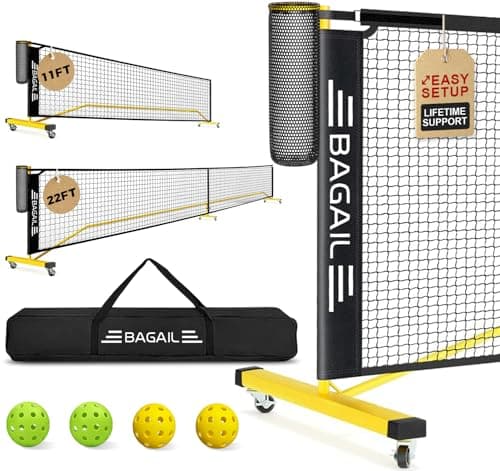
BAGAIL 2-in-1 Net— who it is for: most people, and anyone who is not sure whether they want a full court or a half. A steel, tool-free snap-together frame that assembles as a 22-foot regulation net or an 11-foot half-court net, with wheels, a ball collector and a carry bag. The two configurations are the reason to buy it: full court for a game, half court for drills or a tight driveway. Caveat: a snap-together steel frame will not hold tension like a winched rail, so follow the tensioning order above carefully.
| Size | 22 ft full or 11 ft half-court |
|---|---|
| Frame | Steel, tool-free snap-together |
| Portability | Wheels, ball collector and carry bag |
| Extras | Two configurations from one net |
| Best for | Value shoppers who want flexibility |
A11N Pro Net— who it is for: clubs, rec centers, and anyone who sets up daily and is tired of sag. A heavy-duty steel frame with a hand winch that tensions the top rail, which is the single feature that actually solves the center-sag problem, plus built-in wheels and a carry bag at tournament regulation 22 feet. Caveat: heavy-duty means heavy — this is a net you wheel out of a garage, not one you carry to a park.
| Size | 22 ft, tournament regulation |
|---|---|
| Frame | Heavy-duty steel with hand winch |
| Anti-sag | Winch-tensioned top rail |
| Portability | Built-in wheels + carry bag |
| Best for | Clubs, rec centers, daily play |
Franklin Half-Court Net— who it is for: kids, warm-ups, and driveways that are not 22 feet wide. A 10-foot half-court steel net that goes up in about a minute and ships with two paddles and two X-40 balls, which makes it a complete get-playing-today purchase. Caveat: it is explicitly not a regulation court — good for dinking practice and kids, not for playing real games.
| Size | 10 ft, half-court |
|---|---|
| Includes | Net plus 2 paddles and 2 X-40 balls |
| Frame | Steel, quick setup |
| Setup | About a minute |
| Best for | Kids, warm-ups, tight driveways |
| Net | Size | Anti-sag | Best for |
|---|---|---|---|
| BAGAIL 2-in-1 | 22 ft or 11 ft half | Snap-together steel, no winch | Most people |
| A11N Pro | 22 ft regulation | Hand-winched top rail | Daily and club use |
| Franklin Half-Court | 10 ft half-court | Short span, minimal sag | Kids and tight spaces |
The bottom line
Build the frame flat, attach the net before standing it up, set the posts 22 feet apart, tension the top rail before the center strap, and measure 36 inches at the posts and 34 at the center with a tape. Weight the feet. That is the whole job, and done in that order it takes about five minutes.
If your net still sags after all that, the net is the problem rather than your method, and a winch-tensioned top rail is what you are missing. More options on best portable pickleball nets, and the budget end on best cheap pickleball nets.
Frequently asked questions
How do you set up a portable pickleball net?
Assemble the frame flat on the ground with every joint fully seated, attach the net to the top rail while it is still flat, stand it up and walk the feet to 22 feet apart, then tension the top rail before tightening the center strap. Finish by measuring 36 inches at the posts and 34 inches at the center with a tape, and weight each foot. In that order it takes about five minutes.
What height should a pickleball net be?
36 inches at the posts and 34 inches at the center, measured from the playing surface to the top of the net cord or tape. The two-inch drop in the middle is specified, not a sag. Most driveway setups end up at 31 or 32 inches in the center because the height is eyeballed rather than measured, which makes dinks and drops easier at home than they will be at a club.
How wide is a pickleball net?
22 feet, which is the full width of a pickleball court. Half-court nets are typically 10 or 11 feet and are fine for drills, warm-ups and kids but are not a regulation court. If you are struggling to reach 22 feet when standing the net up, a frame joint is usually not fully seated.
Why does my pickleball net sag in the middle?
Four causes, in order of likelihood: the center strap was tightened before the top rail, which pulls the posts inward; the posts are closer than 22 feet, leaving slack in the top edge; a frame joint is not fully seated; or the net simply has a thin top rail and no winch to take up slack. The first three are free to fix, the fourth is what you pay more for.
Can you set up a portable pickleball net on a tennis court?
Yes, and it is one of the most common uses. Many tennis courts already carry pickleball lines; where they do not, a half-court net is often the better choice because it is quicker to set up and has less sail area in wind. Check the facility's rules first, and never anchor anything into a court surface.
How do you stop a portable net blowing over?
Weight every foot with a sandbag, water jug or your gear bag, and orient the net so the wind runs along its length rather than into its face. Above about 20 mph a lightweight portable net will move regardless, and outdoor balls fly unpredictably in gusts anyway - a heavier winch-tensioned net with built-in wheels copes far better.
Sources
Keep reading
Upgrading your paddle or gearing up to play?
See how we pick, then dig into the paddle roundups and buying guides — honest picks from someone who actually plays, with no inventory to move.