Paddle Review
Gearbox GX6 Control Review
Gearbox sells the GX6 in four combinations of weight and grip size, which tells you everything about who it is for - players who already know exactly what they want and are tired of compromising.
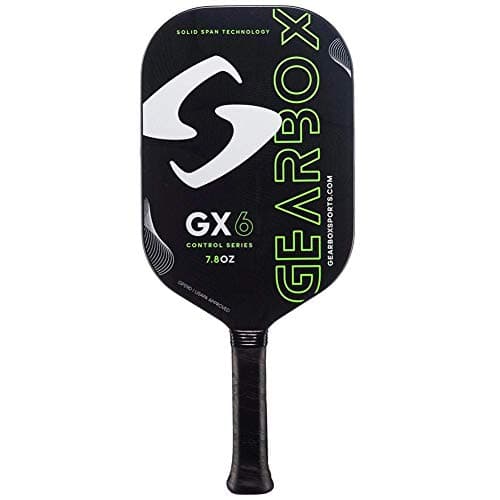
The most specifiable paddle in the sport and one of the most distinctive to hit - superb for touch players who want a solid, quiet face and can live without an edge guard.
- Best for
- Touch and reset players who want a damped, connected feel
- Price context
- Mid-premium tier
Most paddle brands sell you a paddle. Gearbox sells you a configuration. Go to buy a GX6 and you are asked for a weight (7.8 or 8.5 oz), a grip circumference (3 5/8 or 3 15/16 in), and a variant (Control or Power). That is four combinations per variant, which is close to unheard of in a sport where most brands ship one weight and one grip and expect you to adapt.
This is a research-plus-play review of the GX6 Control at 7.8 ozwith the smaller 3 5/8 in grip — the configuration currently stocked on Amazon. Construction details are verified against Gearbox's published specifications; the on-court notes reflect time with Gearbox's solid-core paddles, which share the same fundamental character across the range.
How Gearbox builds a paddle
The whole sport, with a handful of exceptions, builds paddles the same way: a composite face bonded to a polymer honeycomb core, wrapped in a plastic edge guard. Gearbox does not. The GX line uses a solid-core carbon constructionin an edgeless-style frame — there is no hollow honeycomb to compress and no separate edge strip holding the sandwich together.
The consequence you feel immediately is the sound. A honeycomb paddle rings; a Gearbox thuds. Less of the impact energy goes into ringing a hollow structure, so what reaches your hand is a solid, connected thump that tells you precisely where on the face the ball landed. Touch players tend to either love this or bounce off it entirely, and there is not much middle ground.
The order matrix nobody explains
Because Gearbox lists weight and grip as separate SKUs, listings look confusingly duplicated. Here is what the choices actually mean.
| Option | What it changes | Choose it if |
|---|---|---|
| 7.8 oz | Quicker in the hand, less tiring, less mass behind contact | You play a lot of net exchanges or want a light paddle |
| 8.5 oz | More plow-through against pace, more stable, more arm load | You block and reset against hard hitters |
| 3 5/8 in grip | Smaller circumference, more wrist freedom for spin | You have smaller hands or want to snap the wrist |
| 3 15/16 in grip | Larger circumference, less squeezing, steadier face | You have larger hands or grip too tightly |
| Control variant | Tuned for touch, resets and placement | You win points at the kitchen line |
| Power variant | Tuned for pace and put-aways | You win points from mid-court |
Two practical notes. First, grip is easier to fix upward than downward — a small grip can be built up with an overgrip (see our best overgrips roundup and grip size guide), so if you are between sizes, order smaller. Second, weight is not fixable in either direction once you have bought — well, upward it is, with lead tape, which our lead tape guide covers. Downward it is not. So order the lighter one if you are unsure.
Edgeless: the good and the bad
The good.An edge guard is a strip of plastic sitting on the outer half-inch of the face. Balls that land there hit plastic and die. Remove it and that half-inch becomes usable paddle, which materially enlarges the effective hitting area — particularly out toward the sides, where a lot of stretched volleys land.
The bad. The edge guard is also armor. Scrape a paddle on the court reaching for a low ball and an edge-guarded paddle loses some plastic; an edgeless paddle chips the composite itself. That is cosmetic at first and structural eventually. If you are a diver, or you play on rough outdoor courts, this is a genuine consideration.
How it plays
Resets are its best shot. The damped, solid face absorbs pace on a block without the trampoline effect that a lively honeycomb core gives you, so balls die shorter with less effort. That is the single strongest argument for this paddle and why it earns its place in our best control paddles roundup.
Spin is adequate, not exceptional. The carbon face grips, but this is not a modern raw-carbon thermoformed surface and it does not bite like one. If maximum topspin is your priority, the paddles in our best spin paddles roundup will do more for you.
It asks something of your arm. A solid core absorbs less impact than a honeycomb one, so more of each hit reaches you. At 7.8 oz that is manageable for most players, but if you have elbow history, start with our best paddles for tennis elbow page rather than here.
Who it's for (and who should skip it)
Buy it if you are a touch player who wants a quiet, planted, low-vibration face; if you have hands that a standard 4 1/4 in grip has never fitted; or if you have tried a Gearbox before and understood immediately why people stay with the brand.
Skip it ifspin is your primary weapon, if you have an elbow you are managing, or if you play on rough courts and scrape paddles regularly. Skip it too if you want the biggest possible sweet spot for the money — a 16mm widebody will be more forgiving, and our best widebody paddles roundup covers those.
GX6 vs GX2 Hyper
Both are Gearbox solid-core paddles, and they are aimed at opposite players. The GX2 Hyperis the modern power expression — an SST 2.0 carbon core and an aerodynamic shape, built to produce ball speed and punishing if your soft game is not there. The GX6 Control is the older, calmer paddle: same construction philosophy, tuned for touch, cheaper, and considerably easier to live with.
If you want to know what a Gearbox feels like before committing to the flagship, the GX6 is the sensible entry point — and for a lot of control players it is also the destination.
Verdict
The GX6 Control is a genuinely distinctive paddle in a market where most flagships now feel like one another. The solid-core build gives you a quiet, connected face that is excellent for resets and blocks, the edgeless frame hands back face area that most paddles waste, and the weight-and-grip matrix means you can actually fit the paddle to your hand. In exchange you give up some spin, some arm comfort, and the protection of an edge guard. For a touch player who knows their preferences, that is a good trade; for a spin-first player or anyone managing an elbow, it is not. If the GX6 is out of stock when you look — it often is — our best Gearbox pickleball paddlesroundup ranks the models that are currently buyable across the GBX, CX and G families. If you are deciding between Gearbox's solid-core approach and the brand most players cross-shop it with, read Gearbox vs JOOLA.
What we liked
- Solid, quiet, connected feel that touch players consistently prefer
- Edgeless-style frame keeps the face usable right out to the edges
- Four weight-and-grip combinations, so you fit the paddle to your hand rather than the reverse
- Long-running model with a well-established track record
What gave us pause
- Stiffer construction transmits more to the arm than a honeycomb paddle
- Less spin than modern raw-carbon thermoformed faces
- No edge guard means face damage is a real risk if you scrape the court
Frequently asked questions
What makes Gearbox paddles different?
Construction. Almost every paddle in the sport is a composite face bonded to a polymer honeycomb core inside a plastic edge guard. Gearbox uses a solid carbon core in an edgeless-style frame, with no hollow honeycomb to compress. The result is a quieter, more connected feel with a solid thud instead of a hollow ring, and very consistent behavior on off-center contact.
Which Gearbox GX6 weight should I buy?
7.8 oz if you play a lot of net exchanges, want a quick paddle, or are managing arm fatigue. 8.5 oz if you spend time blocking and resetting against hard hitters, where extra mass gives you plow-through and stability. If you cannot decide, buy the lighter one — you can always add weight with lead tape, but you cannot remove it.
Which Gearbox grip size should I choose?
Gearbox offers 3 5/8 in and 3 15/16 in circumferences. Choose the smaller one if you have smaller hands or like to snap the wrist for spin, and the larger one if you have big hands or catch yourself squeezing the handle. When in doubt go smaller: one overgrip adds roughly 1/16 inch of circumference, but nothing shrinks a grip that is too large.
Is an edgeless pickleball paddle a good idea?
It is a trade-off. Removing the edge guard turns the outer half-inch of the paddle from dead plastic into usable hitting surface, which meaningfully enlarges the effective face — especially on stretched volleys. The cost is protection: scrape an edgeless paddle on the court and you chip the composite rather than a sacrificial plastic strip. If you dive or play rough outdoor courts, weigh that carefully.
GX6 or GX2 Hyper?
GX6 Control for touch players who want a quiet, damped, forgiving face for resets and blocks, at a lower price. GX2 Hyper for aggressive players who finish points and want top-tier ball speed from Gearbox's newer SST 2.0 core — it is stiffer, harder on the arm, and asks for a developed soft game in return.
Sources
Keep reading
- Gearbox GX2 Hyper review →Rally & Dink
- Best Gearbox pickleball paddles →
- Best pickleball paddles for control →
- Pickleball paddle grip size guide →Rally & Dink
- Pickleball paddle weight guide →Rally & Dink
- How to add lead tape to a pickleball paddle →Rally & Dink
- Best widebody pickleball paddles →Rally & Dink
Upgrading your paddle or gearing up to play?
See how we pick, then dig into the paddle roundups and buying guides — honest picks from someone who actually plays, with no inventory to move.