Paddle Review
JOOLA Pro V Review
JOOLA's most expensive paddle is also its most quietly serious one - no signature name on the throat, an NFC chip in the handle, and a build aimed at players who are paid to care about consistency.
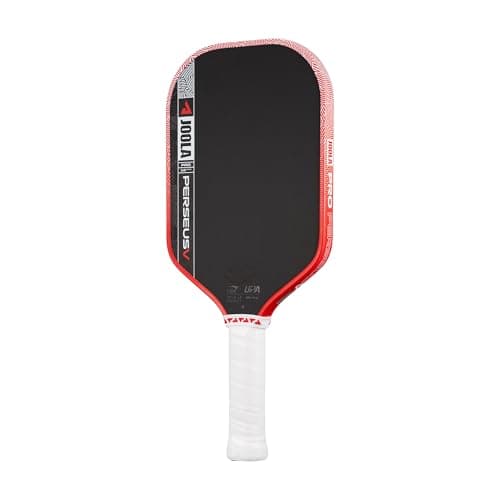
The most complete paddle JOOLA makes, and priced accordingly - a genuine flagship for players whose margins are thin enough that consistency is worth $300.
- Best for
- Advanced and competitive players who already know their preferred core thickness
- Price context
- Top of the premium tier
JOOLA sells paddles two ways. There is the signature route — Ben Johns, Collin Johns, Anna Bright, Agassi — where a name on the throat carries the marketing. And then there is the Pro V, which has no name on it at all and costs more than any of them. It is JOOLA addressing the segment of players who buy on spec sheet rather than on allegiance.
This is a research-plus-play review. The construction details below are verified against JOOLA's published specifications and the current retail listing; the on-court notes come from time on the Perseus and Scorpeus families that share JOOLA's current design language. Where I am extrapolating from a sibling paddle rather than this exact model, I say so.
What the Pro V actually is
Strip the marketing and it is four things: a raw carbon fiber textured surface, JOOLA's Propulsion Core, an enhanced frame, and an NFC chipin the handle. It ships in both 14mm and 16mm, and it carries both USAPA and UPA-A certification — the second of which matters if you compete on the pro tour circuit or in events that have adopted the tour's power ceiling.
"Raw" carbon is the important word on the face. An unpainted, unsealed carbon surface has an inherently rough texture that grips the ball, rather than a printed or sprayed texture applied over a finish. It bites harder and, crucially, keeps biting longer — the mechanism is explained in our carbon fiber vs fiberglass guide.
The Propulsion Core, plainly
JOOLA's Propulsion Core is the company's current premium core construction, and it appears across the top of the range including the Perseus 3S. The practical claim is a core that returns more energy to the ball without the harsh, board-like response that stiff thermoformed paddles can produce — more pop for the same swing, with the impact feel kept civilized.
I would treat that claim the way I treat every core-technology claim: real, but smaller than the marketing suggests. What is observably true across JOOLA's Propulsion-core paddles is that they hit harder than the previous generation at the same thickness, and they do it without feeling like a plank. Whether that is worth the price gap is the actual question, and I answer it in who it's for.
14mm or 16mm: pick before you buy
The Pro V comes in both thicknesses, and this is the single decision that changes the paddle most — more than anything JOOLA writes on the box.
| Core | What you gain | What you give up | Buy it if |
|---|---|---|---|
| 14mm | More pop, faster ball off the face, quicker hands | Some sweet spot, some forgiveness, a firmer feel | You win points by hitting, and your contact is consistent |
| 16mm | A bigger, more forgiving sweet spot, softer resets | A little raw ball speed | You win points at the kitchen, or you are still tightening up contact |
If you genuinely do not know which you want, buy the 16mm. It is the more forgiving mistake. The full trade-off is in our 14mm vs 16mm guide.
The NFC chip is not a gimmick
Every Pro V carries an NFC chip you can tap with a phone to confirm the paddle is a genuine JOOLA. That reads like a marketing flourish until you have watched the counterfeit market around premium paddles. Flagship paddles are among the most cloned items in racquet sports, and fakes are convincing enough that price is no longer a reliable signal.
How it plays
Three things stand out about JOOLA's current premium paddles, and the Pro V is the fullest expression of them.
The face grips hard.Raw carbon at this grade produces genuine, repeatable spin — enough that topspin rolls from below net height become a real shot rather than a hopeful one. It also means the face is a consumable: it collects dust and skin oil, and grit that is clogged does not bite. A wipe between sessions is not optional at this price (our paddle care guide covers it).
The frame keeps the face honest.The enhanced frame construction is aimed at torsional stability — how much the head twists when you catch a ball out toward the edge. This is the least glamorous quality in a paddle and the one that separates flagships from mid-tier paddles in practice, because it decides how much of your bad contact still goes where you aimed.
It does not feel like a plank.The stiffest modern power paddles buy their pace with a firm, unforgiving impact. The Pro V is firm but not harsh — closer to the Perseus family's character than to a solid-core paddle like the Gearbox GX2 Hyper.
Who it's for (and who should skip it)
Buy it if you compete, you already know whether you want 14mm or 16mm, and the difference between a shot landing in and landing a foot out is costing you matches. At that level, torsional stability and a face that holds its grit through a tournament weekend are worth paying for, and the certification and verification chip remove two categories of risk.
Skip it ifyou play recreational doubles and enjoy it. I want to be blunt about this, because the honest version of a flagship review has to include it: the gap between this paddle and a good $100–$150 carbon paddle is real but small, and it lives in margins most club players never operate at. A JOOLA Perseus or a Vatic Pro Prism Flash will give you most of this for a fraction of the money, and you can spend the difference on court shoes, which will do more for your game than any paddle will.
How it compares
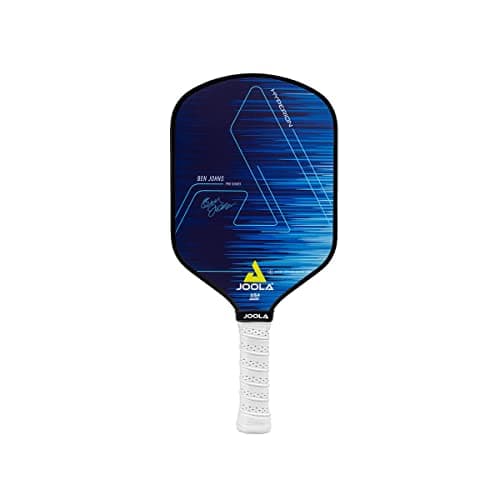
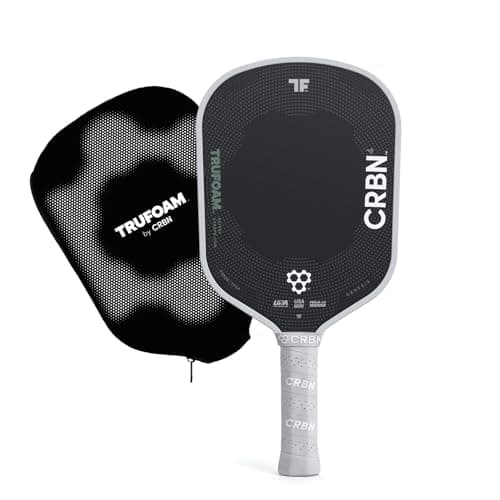
Against JOOLA's own Perseus Pro IV, the Pro V is the less specialized paddle — the Perseus Pro IV is elongated and power-biased, while the Pro V is aimed at complete play with both thicknesses on offer. Against the CRBN TruFoam Genesis, it is the more conventional construction: CRBN's full-foam core is the more radical answer to the same stability problem. And against the Ben Johns Hyperion, it trades the signature elongated shape for a more neutral, spec-led package. All of them sit in our best paddles for advanced players and best JOOLA paddles roundups.
Verdict
The Pro V is the most complete paddle JOOLA sells and the least flashy way it has ever sold one. A raw carbon face that keeps its bite, a core that hits hard without punishing your arm, a frame that keeps mis-hits pointing at the target, both core thicknesses, both certifications, and a verification chip that closes the counterfeit question. If you are competing and your margins are thin, it earns the money. If you are playing Thursday-night doubles and having a great time, it does not — and JOOLA's own cheaper paddles are the better buy.
What we liked
- Raw carbon face with genuine, lasting bite for spin
- Available in both 14mm and 16mm so you can pick your own trade-off
- Enhanced frame keeps the face stable on off-center contact
- NFC verification chip makes counterfeits and gray-market stock easy to spot
- Carries both USAPA and UPA-A certification for sanctioned and pro-tour play
What gave us pause
- Costs roughly twice what an excellent paddle costs
- The performance gap over JOOLA's own mid-tier paddles is small for club players
- Premium raw carbon still needs cleaning to keep its grit
Frequently asked questions
Is the JOOLA Pro V worth the price?
For competitive players, yes — you are paying for torsional stability, a raw carbon face that holds its grit through a tournament, dual USAPA and UPA-A certification, and the choice of 14mm or 16mm. For recreational players the answer is honestly no: a $100 to $150 carbon paddle delivers most of the same performance, and the remaining gap lives at margins most club players never operate at.
Should I get the JOOLA Pro V in 14mm or 16mm?
16mm if you win points at the kitchen line or your contact is still tightening up — it gives you a larger, more forgiving sweet spot and softer resets. 14mm if you win points by hitting and your contact is consistent — it produces more pop and a faster ball off the face, at the cost of some forgiveness. If you genuinely cannot decide, buy the 16mm; it is the more forgiving mistake.
What is JOOLA's Propulsion Core?
It is JOOLA's current premium core construction, used across the top of the range including the Perseus 3S. The design intent is a core that returns more energy to the ball without the harsh, board-like impact that very stiff thermoformed paddles produce. In practice JOOLA's Propulsion-core paddles do hit harder than the previous generation at the same thickness while keeping a civilized feel.
What does the NFC chip in the JOOLA Pro V do?
It lets you tap the paddle with a phone to confirm it is a genuine JOOLA rather than a counterfeit. Flagship paddles are heavily cloned and fakes have become convincing, which matters beyond value for money: a counterfeit paddle's surface and construction were never submitted for approval, so it is not legal for sanctioned play whatever the sticker claims.
Is the JOOLA Pro V approved for tournaments?
Yes. It carries both USAPA certification for USA Pickleball sanctioned play and UPA-A certification used by the pro tour. As always, confirm the specific model and year against the current USA Pickleball approved paddle list before you compete, since approvals are model-and-year specific.
Sources
Keep reading
Upgrading your paddle or gearing up to play?
See how we pick, then dig into the paddle roundups and buying guides — honest picks from someone who actually plays, with no inventory to move.