Court Gear Roundup
The Best Pickleball Court Marking Kits in 2026
A net and two paddles do not make a court. Lines do. Here are the four genuinely different ways to put a 20 by 44 foot court on a driveway, a gym floor or a parking lot - and which kit to buy for each.
The short answer
Quick picks
| # | Product | Best for | Score | Price |
|---|---|---|---|---|
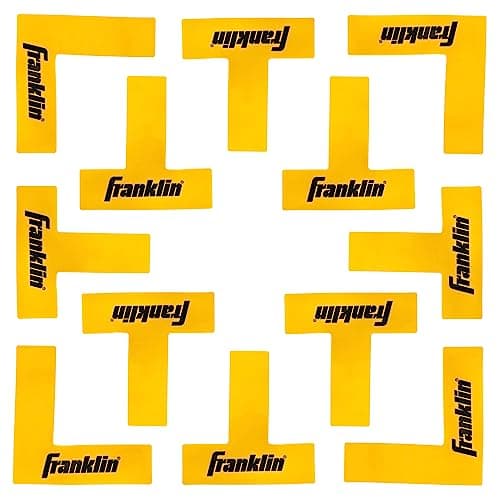
| 01 | Franklin Sports Court Marker Kit L and T shaped corner pieces for about twenty dollars - the fastest honest court. | Best overall | 4.4/5 | $19.99Amazon |
| 02 | 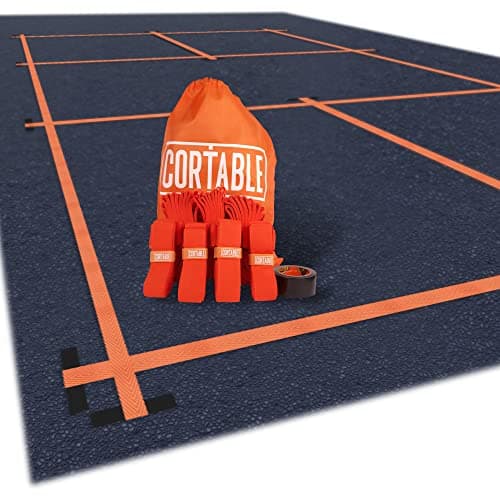 Cortable Temporary Court Lines Continuous pre-measured lines rather than corner spots, with no measuring on site. | Best full line set | 4.3/5 | $67.95Amazon |
| 03 | 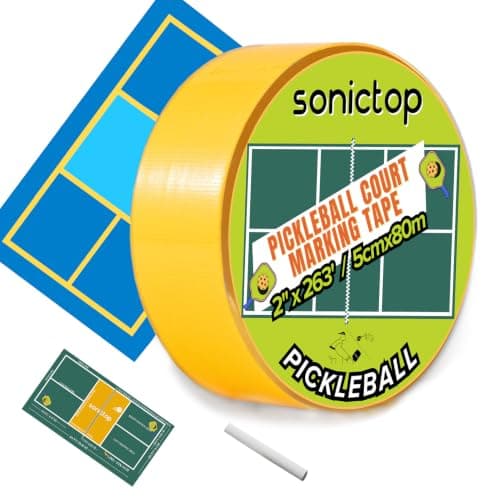 SONICTOP Court Tape, 2 in x 263 ft Regulation-width tape in a three-roll set for under twenty dollars. | Cheapest full court | 4.1/5 | $17.99Amazon |
| 04 | 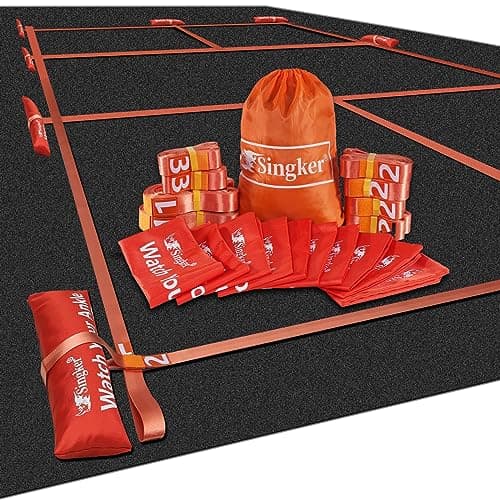 Singker Sandbag-Anchored Court Lines Ten zippered sandbags and nylon webbing - lines that stay put outdoors. | Best for windy courts | 4.0/5 | $54.99Amazon |
| 05 | 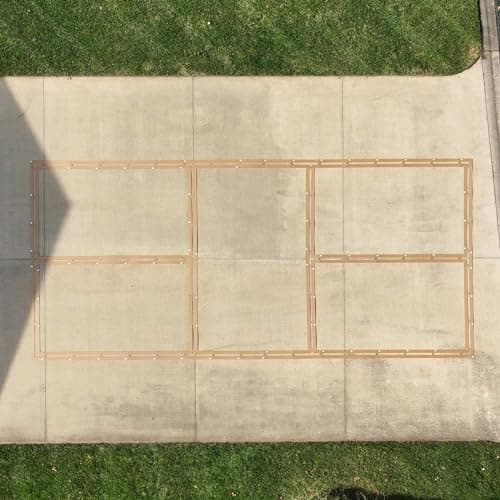 Murray Sporting Goods Stencil Kit Cardboard stencils for painting a regulation court on a driveway. Paint not included. | Best permanent court | 4.0/5 | $99.99Amazon |
| 06 | 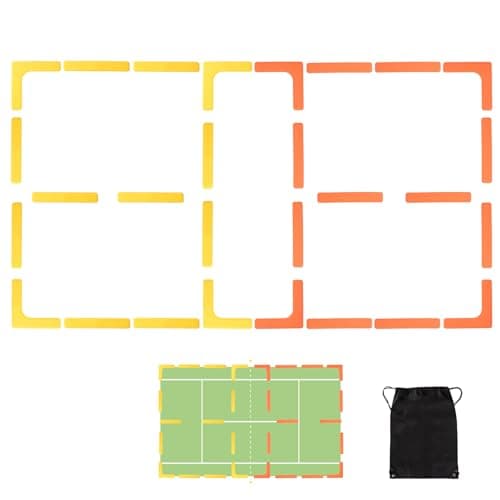 Hikeen Throw-Down Markers, 28 pcs Flat markers for a kitchen line or a partial court - not a full layout. | Best for drills | 3.8/5 | $30.99Amazon |
#ad · Live prices from Amazon as of October 20, 2026; where we have no verified live price we show none. We may earn a commission — see our affiliate disclosure.
The short answer
For most people putting a court on a driveway, a quiet parking lot or a gym floor, the Franklin Sports Court Marker Kitis the right buy: L-shaped corner pieces and T-shaped line markers for about twenty dollars, down in two minutes, up in one. It does not draw continuous lines — it marks the points that matter — and for a casual game that is genuinely enough.
If you want lines you can actually call a ball out on, the Cortable temporary line set gives you continuous pre-measured lines. If you want the cheapest possible full court, the SONICTOP 2-inch tape is regulation line width for under twenty dollars. If the wind takes your lines away every week, the Singker kit with its zippered sandbags is the fix. And if you are done with temporary anything, the Murray stencil kit paints a permanent court on concrete.
The measurements you cannot skip
Before you buy anything, know what you are laying out, because half the frustration with these kits comes from people discovering mid-setup that their driveway is too narrow.
| Element | Dimension |
|---|---|
| Court, total playing area | 20 ft wide x 44 ft long |
| Non-volley zone (kitchen) | 7 ft from the net, full 20 ft width |
| Service court | 15 ft long, 10 ft wide |
| Line width | 2 in |
| Net height | 36 in at the sidelines, 34 in at the center |
| Recommended total space | 30 ft x 60 ft minimum |
Two of those matter more than the rest when you are shopping. Lines are 2 inches wide and the line is part of the court— a ball touching any line except the kitchen line on a serve is in. That is why tape width is not a cosmetic detail: 1-inch tape produces a court where close calls are genuinely ambiguous. And USA Pickleball recommends a minimum total area of 30 by 60 feet, not 20 by 44, because players need room to run off the back. Our pickleball court dimensions guide has the full set including tournament clearances.
The four approaches
Everything sold as a “court marking kit” is one of four things, and they are not interchangeable. Picking the wrong category is the mistake, not picking the wrong brand within it.
1. Spot markers (L and T pieces). Flat shapes you drop at the corners and at the ends of the kitchen and center lines. Your eye joins the dots. Cheapest, fastest, packs into a bag, and completely adequate for recreational play. The honest limit is that line calls become arguments.
2. Full temporary line sets.Continuous strips of vinyl or a rubber-plastic blend that lay out an actual court. These look right and play right. They are also heavier than people expect — one widely sold deluxe line set lists 17 lbs for eight strips and a bag — and most of them are not adhesive. Wilson says of its own vinyl line set that the pieces will not stick to the floor and can move when stepped on, which is honest and applies to the category generally.
3. Tape.Regulation-width tape, rolled out and pressed down. The only approach that gives you a court visually indistinguishable from a real one, and by far the cheapest per court. It is also single-use, takes 30 to 45 minutes to lay properly, and is the one approach that can damage a surface if you buy the wrong product — which is why residue claims matter.
4. Permanent paint. Stencils plus your own paint, on concrete or asphalt you own. Highest effort, highest cost, and the only option that is still there next weekend.
How we picked
In stock with a live price. This category is full of listings that appear and vanish. Every kit here was checked on Amazon on the day of publication and had real availability and a real price.
One pick per approach, plus the two cases that break them. Spot markers, full line set, tape and paint, plus the wind problem and the drills-only use case. We are not ranking six versions of the same product.
Claims limited to what the listing states. This is a category of small and unbranded sellers who publish almost no specifications. Where a maker does not state a material, a thickness or a weight, this page says so. We have not laid out a court with every one of these kits; what we can tell you is what each approach does, what it costs and what the seller actually claims. Our method is on how we review.
At a glance
| Kit | Approach | Court type | Reusable | Best for |
|---|---|---|---|---|
| Franklin Court Marker Kit | Spot markers (L + T) | Partial | Yes | Fast casual setup |
| Cortable Temporary Lines | Full line set | Full | Yes | Lines you can call on |
| SONICTOP tape, 2 in x 263 ft | Tape | Full | No | Cheapest full court |
| Singker sandbag kit | Full line set, anchored | Full | Yes | Wind and open spaces |
| Murray stencil kit | Stencil + your paint | Full, permanent | Stencils are single-use | A driveway you own |
| Hikeen markers, 28 pcs | Spot markers | Partial | Yes | Drills and kitchen lines |
Best overall: Franklin Sports Court Marker Kit
Who it is for: anyone who wants a playable court in under five minutes and does not need to settle line disputes.
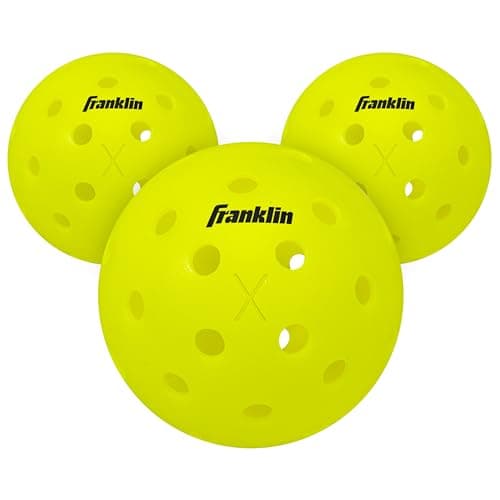
Franklin is the company behind the X-40, the official ball of USA Pickleball, so this is the one kit here from a brand with real standing in the sport — see our Franklin X-40 review, and the paddle range in best Franklin pickleball paddles. The kit is L-shaped corner pieces and T-shaped line markersin high-visibility color, which the listing describes as wipe-clean and portable. PickleballCentral's listing for the same kit describes 12 pieces — four L-shaped corners and eight T-shaped markers — which is exactly the count a 20 by 44 court needs: four corners, four kitchen-line ends, and four centerline ends.
| Type | Spot markers - L-shaped corners plus T-shaped line markers |
|---|---|
| Piece count | 12 per PickleballCentral's listing for the same kit; Amazon's listing does not state a count |
| Material | Not published by Franklin on this listing |
| Court | Marks the key points of a full 20 x 44 layout |
| Care | Wipe clean, per the listing |
What I like: it is twenty dollars, it fits in a paddle bag, it goes down faster than the net does, and the piece count genuinely maps to the court rather than being an arbitrary number. For the driveway-and-portable-net setup most people are actually building — see best cheap pickleball nets— this is the proportionate buy.
What gives me pause: it is not lines. Your eye joins the markers, which works fine until someone hits a ball six inches outside the imaginary sideline and disagrees with you. Franklin does not publish the material, so I cannot tell you how it behaves on a hot blacktop in August. And on grass, flat markers of any kind disappear into the turf.
Best full line set: Cortable Temporary Court Lines
Who it is for: the group that plays on the same spot every week and wants a court that looks and plays like a court.
The Cortable set is the straightforward upgrade from spot markers: continuous pre-measured lines you lay out in a standard court layout with, per the listing, no measuring neededon site. That phrase is doing real work — measuring a 20 by 44 rectangle square, by eye, with a tape measure and two people, is the part of a temporary court that takes twenty minutes and goes wrong.
| Type | Full temporary line set, continuous lines |
|---|---|
| Layout | Pre-measured to a standard court; no on-site measuring per the listing |
| Use | Indoor or outdoor, per the listing |
| Material and weight | Not published on the listing |
| Net | Not included |
What I like: real lines change the game. Calls become calls instead of debates, and the kitchen boundary — the single most-contested line in the sport, as what is the kitchenexplains — is unambiguous.
What gives me pause: the seller publishes no material and no weight, and full line sets are consistently heavier than buyers expect; the widely sold deluxe sets run around 17 lbs. Most sets in this category also do not adhere to the floor and can shift when stepped on, which is the honest trade-off against tape. At around sixty-eight dollars it is more than three times the Franklin kit, and that only makes sense if you play the same spot repeatedly.
Cheapest full court: SONICTOP court tape, 2 in x 263 ft
Who it is for: anyone marking a gym floor, a tennis court or a smooth driveway who wants a proper court and does not mind doing it once.
This is the pick that gets the geometry exactly right, because the tape is 2 inches wide— the regulation line width. The listing describes a three-piece set totaling 263 feet, which comfortably covers the roughly 200 linear feet a full court needs, and claims no-residue removal and easy installation.
| Width | 2 in - the regulation line width |
|---|---|
| Length | 263 ft across a 3-piece set, per the listing |
| Court coverage | A full court needs about 200 linear feet |
| Removal | No residue, per the listing |
| Reusable | No - single use |
What I like: under twenty dollars for a court that is visually correct, and the only approach here that cannot shift underfoot. If you play on one surface and want it to look right, nothing else competes on price.
What gives me pause: it is single-use, so the economics invert if you are setting up weekly — two or three sessions and the Franklin kit is cheaper. Laying 200 feet of straight, square tape takes real time, and the no-residue claim is the seller's, not a tested result. Test it on a hidden patch before you tape someone else's gym floor, and get permission first: facilities have strong opinions about adhesive on hardwood and sealed sport surfaces.
Best for windy courts: Singker sandbag-anchored lines
Who it is for: anyone playing on an exposed parking lot, a beach or an open field where lines will not stay put.
Wind is the failure mode nobody anticipates until the first gust redistributes their sidelines. This kit addresses it directly: the listing specifies 10 zippered sandbags and 8 nylon webbings, so the lines are tensioned webbing held down by weight you fill on site rather than loose strips sitting on the surface.
| Type | Temporary boundary lines, sandbag-anchored |
|---|---|
| Anchors | 10 zippered sandbags, per the listing |
| Lines | 8 nylon webbings, per the listing |
| Fill | Sand or gravel, supplied by you |
| Net | Not included |
What I like: it is the one kit here that solves a problem the others pretend does not exist, and sandbags you fill yourself ship light and weigh plenty once loaded. On an open blacktop this is the difference between a court and a weekly reset.
What gives me pause: you have to source and carry sand, which is the whole point and also a genuine chore — filled bags are heavy to move and the kit is pointless empty. Webbing lines are narrower and less visually convincing than flat line sets, and at around fifty-five dollars you are paying a premium for anchoring rather than for better lines. On a sheltered driveway this is money wasted; buy the Franklin kit.
Best permanent court: Murray Sporting Goods stencil kit
Who it is for: someone painting a regulation court on concrete or asphalt they own and will not need to un-paint.
The Murray kit is cardboard stencils for a regulation backyard court on driveway, asphalt or concrete, per the listing. You supply the paint. What you are buying is the layout — the measuring, the squaring and the 2-inch line widths — pre-solved in physical form, which is worth more than it sounds when the alternative is chalk lines and a 44-foot tape measure.
| Type | Cardboard stencil kit for painted lines |
|---|---|
| Surfaces | Driveway, asphalt or concrete, per the listing |
| Court | Regulation backyard pickleball court |
| Paint | Not included - you supply it |
| Reusable | Cardboard; treat the stencils as single-use |
What I like: permanence. No setup, no takedown, no wind, and a court that is there when you walk outside. For a household that plays several times a week it is the cheapest option measured over a year.
What gives me pause: cardboard stencils and outdoor paint are a one-shot combination — if the stencil tears or shifts mid-job, you are living with it. The kit does not include paint, so the real cost is higher than the listing price, and the stock on this listing was limited when we checked. Most importantly: do not do this on a shared driveway, a rented property or an HOA-governed surface without asking first. Check the layout against court dimensions before the first stroke, because the 30 by 60 foot clearance recommendation still applies to a painted court.
Best for drills: Hikeen throw-down markers, 28 pieces
Who it is for: the player who wants to mark a kitchen line for dinking practice, not build a court.
Twenty-eight flat markers, described by the listing as anti-slip and wind-resistant. That count is far more than a court layout needs, which tells you what it is really for: marking targets, service boxes, footwork patterns and a kitchen line on a surface that already has some lines of its own.
| Type | Flat throw-down markers |
|---|---|
| Count | 28 pieces |
| Claims | Anti-slip and wind-resistant, per the listing |
| Use | Indoor or outdoor; drills and partial layouts |
| Material | Not published on the listing |
What I like: for solo and partner practice it is more useful than a full court. Mark the kitchen line and a couple of targets and you have a dinking session — the drills are in pickleball dinking drills, and the same markers set up third-shot targets for the third shot drop.
What gives me pause: as a court-marking kit it is the weakest thing here. Twenty-eight generic markers do not produce a recognizable court, the material is unpublished, and at around thirty dollars it costs more than the Franklin kit, which is purpose-shaped for the job. Buy this for drills or do not buy it.
What works on which surface
Concrete or asphalt driveway. Anything works. Spot markers for speed, tape for a real court, stencil paint if you own it. Rough asphalt chews adhesive tape, so test a short strip before committing a full roll.
Gym or sport-court floor. Tape or a weighted line set, and permission first. Many facilities ban adhesive on finished hardwood outright. Loose vinyl lines on a polished floor are a slip risk, which is the one place the anchored kits earn their money indoors.
Tennis court. Tape, every time. The existing lines give you a reference to square against, and a pickleball court fits inside a tennis court with room to spare.
Grass or dirt. Nothing in this category works well. Flat markers vanish into turf, tape will not adhere, and paint is not an option. Anchored webbing lines are the least bad answer.
Beach or open parking lot. Anchored lines only. This is the whole reason the sandbag kit exists.
The bottom line
Most people overbuy here. If you are putting a court on a driveway for family games, the Franklin Court Marker Kit at twenty dollars is the right answer and the extra forty-five dollars for a full line set buys you argument-free line calls you may never need.
Buy the Cortable line set if you run a regular weekly game and want a real court, the SONICTOP tape if you want the cheapest correct court and will only lay it once, the Singker sandbag kit if wind is already beating you, and the Murray stencil kitif the surface is yours and you are done setting up. Then spend the difference on a decent ball — best pickleball balls— because that changes the game more than the lines do.
Frequently asked questions
What size is a pickleball court?
A pickleball court is 20 feet wide by 44 feet long, the same size for singles and doubles. The non-volley zone (the kitchen) extends 7 feet from the net on each side across the full 20-foot width, and each service court is 15 feet long by 10 feet wide. Lines are 2 inches wide. USA Pickleball recommends a minimum total playing area of 30 by 60 feet so players have room to run off the back.
How much tape do I need to mark a pickleball court?
About 200 linear feet. The perimeter takes 128 feet - two 20-foot baselines and two 44-foot sidelines - the two kitchen lines take 40 feet, and the two centerlines take 30 feet, running 15 feet each from the kitchen line to the baseline. Buy 2-inch wide tape, which is the regulation line width; 1-inch tape makes close calls genuinely ambiguous.
What is the best way to mark a temporary pickleball court?
It depends on the surface and how often you set up. For a quick recreational court, L and T shaped spot markers like the Franklin kit go down in under five minutes for about twenty dollars. For a court you can make real line calls on, a continuous temporary line set is better. On a gym floor or tennis court, 2-inch tape gives the most accurate result. Outdoors in wind, use a kit with sandbag anchors.
Do temporary pickleball court lines stay in place?
Often not. Most throw-down vinyl and rubber line sets are not adhesive - Wilson states of its own vinyl set that the pieces will not stick to the floor and can move when stepped on, and that applies broadly to the category. Tape is the only approach that genuinely cannot shift underfoot, and sandbag-anchored kits are the answer outdoors where wind is the problem.
Can you paint pickleball lines on a driveway?
Yes, on concrete or asphalt you own, and a stencil kit is the sensible way to do it because it solves the measuring and squaring for you. You supply the paint. Do not paint a shared driveway, a rental or an HOA-governed surface without permission, and check your layout against the regulation dimensions before you start, because a painted mistake is permanent.
How wide should pickleball court lines be?
Two inches. That is the regulation line width, and it matters for play rather than looks: the line is part of the court, so a ball touching any line except the kitchen line on a serve is in. Narrower lines make those calls harder to judge, which is the main reason to buy tape sold at 2 inches rather than general-purpose marking tape.
Sources
- USA Pickleball - official rulebook and court dimension standards
- PickleballCentral - Franklin Pickleball Court Marker Kit piece count
- PickleballCentral - EZ Court Lines and Deluxe Pickleball Line Set product details (material, weight, adhesion)
- Amazon listings for each kit - price, stock and stated contents, checked 2026-10-20
Keep reading
Upgrading your paddle or gearing up to play?
See how we pick, then dig into the paddle roundups and buying guides — honest picks from someone who actually plays, with no inventory to move.