Spec Guide
Pickleball Paddle Twist Weight, Explained
Twist weight is the spec that decides what happens on the ball you do not hit cleanly - which is most of them. It is also the one number almost no manufacturer publishes, and the published figures that do exist do not agree with each other.
What twist weight is
Twist weight is a paddle's resistance to rotating about its own long axis — the axis that runs from the butt cap up through the middle of the face. Hit a ball out toward the edge of the paddle and it tries to spin the face in your hand, like catching a ball on the end of a spanner. High twist weight resists that rotation, so the face stays closer to where you aimed and the ball goes roughly where you intended. Low twist weight means the same contact sends the ball off weak and sideways.
It is the third of the three weight numbers, and the three are genuinely different things. Static weight is what the paddle weighs on a scale. Swing weightis resistance to rotation about the handle — what your arm feels, and what governs hand speed and plow-through; our swing weight guide covers it in full. Twist weight is resistance to rotation about the long axis, and it governs one thing only: what happens when you miss the middle.
| Spec | Rotation about | What it governs | Driven mostly by |
|---|---|---|---|
| Static weight | Nothing - it is just mass | Fatigue, and the feel of the paddle at rest | Total material used |
| Swing weight | The handle | Hand speed, plow-through, power | Length and where mass sits along it |
| Twist weight | The paddle's long axis | Off-center contact near the edges | Width and mass out at the sides |
Why it matters more than you think
Because almost nobody hits the middle. Watch a recreational doubles game and count the balls struck dead center — it is a minority, and in a fast kitchen exchange it is a small minority. Every other ball is a partial mishit, and twist weight is the spec that decides whether a partial mishit is a playable ball or a free point for the other team.
That is also why “bigger sweet spot” marketing is usually a twist weight claim in disguise. A paddle is not actually more forgiving in the middle; it is less punishing at the edges, and what makes the edges less punishing is mass and structure out at the sides. Our sweet spot guide works through the whole idea, and best widebody paddles is the roundup of the shape that maximises it.
Two groups should care about twist weight more than anyone: improving players whose contact is still inconsistent, and anyone who plays a lot of defense, where you are reaching and blocking rather than setting up. If you are neither — if your contact is clean and your game is built on hitting through the ball — swing weight is the more useful number for you.
The numbers, and why they disagree
Here is the honest state of this spec: brands almost never publish it, and the independent sources that do measure it use different units and different methods, so their numbers cannot be compared with each other.
Pickleball Unionreports twist weight in kg·cm² and describes roughly 10–12 as lower stability, 13–15 as moderate forgiveness, and 16 or above as very stable. Pickleball Sciencereports it in oz-in² instead, and across more than forty paddles found an average near 27, a low near 23 (the ProKennex Pro Flight) and a high near 32 (the CRBN 2X).
Those two scales do not reconcile — converting the oz-in² average lands well below the kg·cm² bands, which means the methods and pivot assumptions differ rather than one being wrong. The practical rule that follows is simple and worth remembering: compare twist weight numbers only within a single source's dataset, and never across two reviewers or two websites.
What actually raises twist weight
Three things, in order of how much they matter.
Width.This is the big one. Twist weight scales with how far the mass sits from the long axis, so a wider face raises it dramatically — and because USA Pickleball caps length plus width at 24 inches, every inch of width is bought with an inch of length. That is the whole reason a widebody paddle feels forgiving and an elongated paddle does not.
Mass at the perimeter. A foam-filled edge wall or foam-injected perimeter puts material exactly where it does the most good, which is why modern thermoformed paddles forgive edge contact so much better than the cold-pressed paddles they replaced. See thermoformed vs cold-pressed.
Structural stiffness.A rigid frame resists twisting even without extra mass, which is the Gearbox argument — a solid carbon structure flexes and rotates less than a face glued over honeycomb.
Notice what is not on that list: core thickness, face grit, and static weight. A heavier paddle does not automatically have a higher twist weight; an 8.5 oz elongated paddle with its mass up the middle can twist more than a 7.9 oz widebody.
Paddles with high twist weight
#ad· The buy buttons in this section are affiliate links, and every price they show comes from our live price feed with the date it was captured.
Three paddles we carry that are built the way a high-twist-weight paddle is built — wide faces, foam perimeters, rigid structures. None of these brands publishes a twist weight figure, so these are recommended on the construction specs that drive it, not on a number.
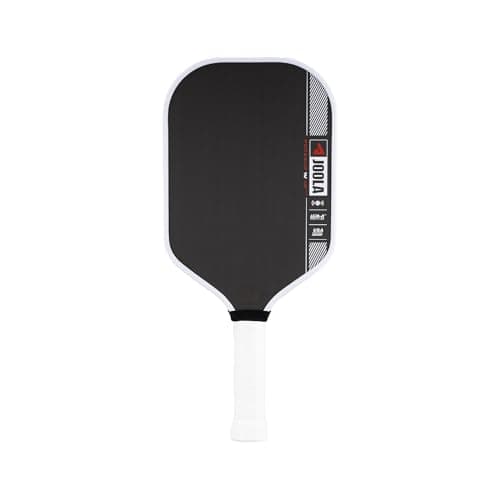
JOOLA Perseus Pro IV 16mm — foam outside the frame. JOOLA puts a foam edge wall around a 16mm Honeycomb Propulsion core, which is mass placed precisely where it resists twisting. It is the most forgiving elongated paddle on this site, which is a strange sentence until you understand twist weight: the shape works against it and the construction claws it back.
| Core | 16mm Honeycomb Propulsion with foam edge wall |
|---|---|
| Shape | Elongated, 16.5 x 7.5 in |
| Weight | 8.1 oz average (7.9-8.3 oz) |
| Surface | Carbon with JOOLA's Charged Surface Technology |
| Why it is here | Perimeter foam - mass at the sides, not up the middle |
CRBN X Series Power 3X 16mm — foam-injected edges, by design.CRBN sells this line explicitly on an expanded sweet spot from foam-injected edges, which is a twist weight claim stated in plain language. Worth noting that the one paddle Pickleball Science measured highest for twist weight in its dataset was a CRBN — a different model, but the same design philosophy.
| Core | 16mm with foam-injected edges |
|---|---|
| Surface | Carbon fiber |
| Shape | 3X (elongated) |
| Line | X Series - positioned as Gen-3 power and spin |
| Why it is here | Foam at the perimeter is the whole pitch of the line |
Gearbox CX14H Ultimate Power — width plus rigidity. An unusually wide 15.625 by 8 inch head on a solid SSTcore structure, at 8.5 oz. Wide face, rigid frame, mass spread through the structure: that is the recipe, and nothing we carry twists less on a mishit. The cost is that it is also the harshest paddle here on an arm.
| Surface | 3K woven carbon fiber (Toray T-700) |
|---|---|
| Core | 14mm patented SSTcore with Power Band |
| Dimensions | 15.625 x 8 in (Hyper shape) |
| Weight | 8.5 oz |
| Why it is here | An 8 in face on a rigid single-piece structure |
Adding twist weight yourself
This is the part most players skip, and it is the cheapest upgrade in the sport. You cannot widen a paddle, but you can move mass out to its sides.
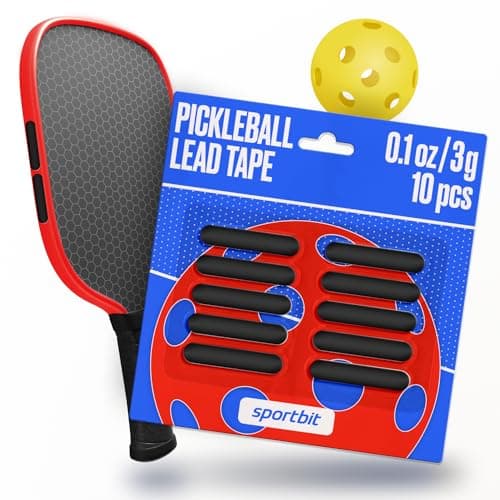
Tape at 3 and 9 o'clock— a strip on each side of the face, level with the widest point — raises twist weight with only a modest increase in swing weight, because the mass is out to the sides rather than up at the tip. Two short bars of lead or tungsten tape cost a few dollars, add roughly three grams each, and are completely reversible. Tape at 12 o'clock does the opposite job: it raises swing weight and plow-through and does comparatively little for twisting.
Start with one bar per side and play a session before adding more. Our lead tape guide covers placement, the legality rules and how much is too much.
| Product | SPORTBIT lead tape for pickleball paddles |
|---|---|
| Placement for twist weight | 3 and 9 o'clock - level with the widest point of the face |
| Placement for plow-through | 12 o'clock - raises swing weight instead |
| Typical addition | About 3 g per bar |
| Reversible | Yes - unlike buying a different paddle |
What twist weight costs you
Nothing is free. Raising twist weight means adding mass away from the long axis, and that mass goes somewhere.
Reach. Width is bought with length under the 24-inch rule, so the most stable-on-mishits paddles are also the shortest. If you play singles, or you rely on reach at the net, that is a genuine loss rather than a technicality.
Some hand speed. Tape at the sides raises swing weight too, just less than tape at the tip does. Add enough and you will feel the paddle slow down in a fast exchange.
Spin leverage. Elongated paddles generate spin more easily because the contact point is further from your hand. Trading length for width trades some of that away, which is why high-spin players often accept a lower twist weight on purpose.
The useful way to hold all of this: twist weight is insurance. If your contact is reliable, you do not need much of it and you are better off spending the budget on reach or swing weight. If your contact is not reliable — and for most club players it is not — it is the cheapest performance you can buy.
The bottom line
Twist weight governs the balls you do not hit cleanly, which is most of them. You cannot shop on the published numbers because the two public datasets use incompatible units and no brand quotes a method — so shop on the specs that drive it instead: a wider face, a foam-filled perimeter, a rigid frame. And before you buy anything, try two strips of tape at 3 and 9 o'clock on the paddle you already own. It costs a few dollars, it is reversible, and it is the same physics the expensive paddles are selling you.
Frequently asked questions
What is twist weight on a pickleball paddle?
Twist weight is the paddle's resistance to rotating about its own long axis - the axis running from the butt cap up through the middle of the face. It governs what happens on contact out toward the edges: a high twist weight keeps the face from turning in your hand, so the ball still goes roughly where you aimed, while a low twist weight sends the same ball off weak and sideways.
What is a good twist weight for a pickleball paddle?
There is no single answer, because the public figures use incompatible scales. Pickleball Union reports twist weight in kg-cm-squared and calls roughly 10-12 lower stability, 13-15 moderate and 16-plus very stable; Pickleball Science reports it in oz-in-squared, where its forty-paddle dataset averaged about 27. Those numbers do not convert into each other, so compare twist weights only within one source's dataset.
What is the difference between swing weight and twist weight?
Swing weight is resistance to rotation about the handle, and it governs hand speed, plow-through and power - it is driven by length and where mass sits along it. Twist weight is resistance to rotation about the paddle's long axis, and it governs off-center contact near the edges - it is driven by width and mass out at the sides. A paddle can be high in one and low in the other.
How do I increase the twist weight of my paddle?
Put lead or tungsten tape at 3 and 9 o'clock - one short bar on each side of the face, level with the widest point. That places mass as far from the long axis as the paddle allows, which raises twist weight while adding comparatively little swing weight. Each bar adds around three grams, it costs a few dollars, and it is fully reversible. Tape at 12 o'clock raises swing weight instead.
Do widebody paddles have higher twist weight?
Yes, and that is the main reason they feel forgiving. Twist weight scales with how far the paddle's mass sits from its long axis, so a wider face raises it substantially. Because USA Pickleball caps length plus width at 24 inches, that width is paid for in length - which is why widebody paddles forgive mishits but give up reach and some spin leverage.
Why do manufacturers not publish twist weight?
Partly because there is no agreed measurement standard, and partly because it is an unflattering number for elongated paddles, which sell well. The specs brands do publish - face dimensions, shape, and whether the perimeter is foam-filled - predict twist weight well enough to shop on, and independent testers publish rankings that are useful as long as you compare within a single dataset.
Sources
- Pickleball Union - paddle specs explained, including twist weight bands in kg-cm-squared
- Pickleball Science - twist weight measurements in oz-in-squared across 40+ paddles
- USA Pickleball - equipment standards (including the 24 in length-plus-width limit)
- JOOLA - Perseus Pro IV construction and specifications
- CRBN Pickleball - X Series construction and foam-injected edges
Keep reading
Upgrading your paddle or gearing up to play?
See how we pick, then dig into the paddle roundups and buying guides — honest picks from someone who actually plays, with no inventory to move.