Buying Guide
Pickleball Paddle Swing Weight, Explained
Two paddles can weigh the same on a scale and feel nothing alike in your hand. Swing weight is why - and it is the most useful paddle number almost nobody shops on.
The short answer
Swing weight is how heavy a paddle feels while you are swinging it, and it depends on where the mass sits rather than how much of it there is. It is a measure of resistance to rotation about the handle: the further mass is from your hand, the higher the swing weight and the more effort it takes to accelerate and stop the paddle.
That single fact explains the thing that confuses most buyers. An elongated 8.0 oz paddle with mass out at the tip can feel distinctly heavier in a fast kitchen exchange than an 8.3 oz widebody with its mass near the throat, even though the scale says the opposite. Static weight is what the paddle weighs. Swing weight is what it feels like. When the two disagree, trust swing weight.
The three weight numbers
Static weight is what the paddle reads on a kitchen scale, in ounces or grams. Current paddles run from about 7.3 oz to about 8.5 oz. It is the only one of the three that is reliably published, which is why everyone shops on it. It tells you something real about arm load over a long session and very little about how the paddle handles.
Swing weightis resistance to rotation about the handle — the moment of inertia, if you want the physics word. Higher means more plow-through and more stability on contact, and slower hands. Lower means faster hands and less free power.
Twist weight is resistance to rotation about the long axis of the paddle, through the middle of the face. It decides what happens when you hit the ball off-center towards the edge: a high twist weight resists the face turning in your hand, so the ball still goes roughly where you aimed. A low twist weight means an off-center ball comes off weak and sideways. Width drives twist weight, which is the real reason wide paddles feel forgiving.
Those three are independent. A paddle can be light and high swing weight (thin, long, mass at the tip), or heavy and low swing weight (mass concentrated at the throat), or wide with a high twist weight and a modest swing weight. This is why "what weight paddle should I buy?" is an incomplete question — our paddle weight guide covers the static-weight half, and this page covers the rest.
Typical ranges and what they feel like
Independent testers generally report pickleball swing weights in the low-100s to the mid-120s on the kg·cm² scale borrowed from tennis. The exact numbers vary by tester, so treat these as bands rather than thresholds:
| Band | Feels like | Suits | Costs you |
|---|---|---|---|
| Low | Whippy, quick, almost weightless in the hand | Doubles players who lose hands battles; sore arms | Plow-through and stability on contact |
| Medium | Balanced - the default most paddles target | Almost everyone, at almost every level | Nothing in particular; it is the compromise |
| High | Heavy, stable, powerful, slow to redirect | Singles, drive-first games, tennis converts | Hand speed in fast kitchen exchanges |
The useful heuristic: if you keep getting beaten to the ball in hands battles at the kitchen line, you want lower. If your drives land short and off-center balls feel weak and unstable, you want higher.
What swing weight changes in play
Hand speed.The most noticeable effect. A low swing weight gets the paddle to a ball you had no business reaching, which in doubles is where points are decided — see best paddles for doubles.
Plow-through and power. More mass resisting deceleration means the paddle keeps moving through contact, so the ball comes off harder for the same swing. This is why head-heavy paddles drive well and why adding tape at the tip is the classic power modification.
Stability. Higher swing weight resists the paddle being knocked around by a hard incoming ball, which makes blocks and counters more predictable.
Arm load. Every acceleration and deceleration is work for the shoulder, elbow and wrist, and higher swing weight means more of it. If you are managing tennis elbow or arthritis, lowering swing weight is one of the three levers that genuinely help, alongside grip circumference and a thicker core.
Serve and overhead depth. On full swings, where you have time to accelerate, higher swing weight is an advantage. It is only in the fast, short-swing exchanges that it becomes a liability.
Why shape drives swing weight
Shape is a better predictor of swing weight than static weight is, because shape decides where the manufacturer can put the mass.
Elongated paddles— roughly 16.5 x 7.5 inches — put material further from your hand by definition, so they run higher swing weights and feel more powerful and more stable, at the cost of hand speed. See best elongated paddles.
Widebody paddles— roughly 15.5 x 8.1 inches — put material out to the sides instead, which raises twist weight and keeps swing weight moderate. That combination is why they feel forgiving and quick at once: best widebody paddles.
Hybrid and standard shapes sit between the two, which is why they are the default recommendation for players who do not have a strong preference.
Our paddle shapes guide covers the geometry properly. The short version: if you want low swing weight, start by looking at shorter, wider paddles, not just lighter ones.
How to change it on a paddle you own
This is the part worth knowing before you buy anything. Swing weight is one of very few paddle properties you can change yourself, cheaply and reversibly, with a few grams of lead tape. Position matters more than quantity:
Tape at the tip (12 o'clock) raises swing weight the most per gram. Two grams there is noticeable; four is a different paddle. Use this for power and plow-through.
Tape at the sides (3 and 9 o'clock) raises twist weight with a smaller swing-weight penalty. This is the stability-without-sluggishness modification, and the one most players should try first.
Tape or a heavier grip at the handle raises static weight while lowering effective swing weight, because it moves the balance point towards your hand. This is the counter-intuitive one: a heavier paddle that swings lighter. It is also the cheapest fix for a paddle that feels sluggish in hands battles.
Add tape in small increments, play with it, and keep going only if the change helped. Our step-by-step guide to adding lead tape covers placement, quantity and the legality rules, and it is worth reading before you order a replacement paddle you may not need.
What to buy
Three things, in the order they make sense: the tape to adjust what you already own, a genuinely low swing weight paddle, and a genuinely high one.
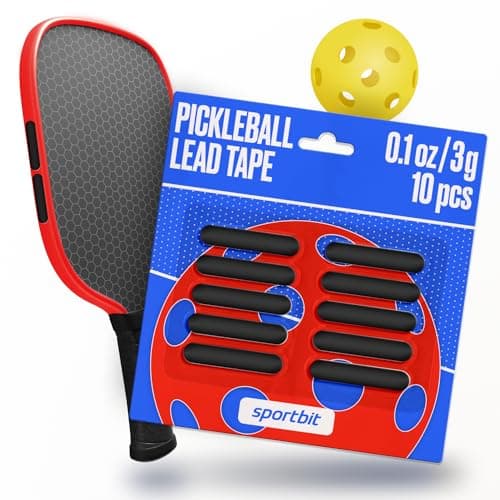
SPORTBIT lead tape— who it is for: anyone who likes their paddle but wishes it were quicker, or heavier, or more stable. This is the cheapest meaningful change you can make to a paddle, and it is reversible. Buy it before you buy a replacement paddle; four grams and ten minutes answers a question that a hundred dollars might not.
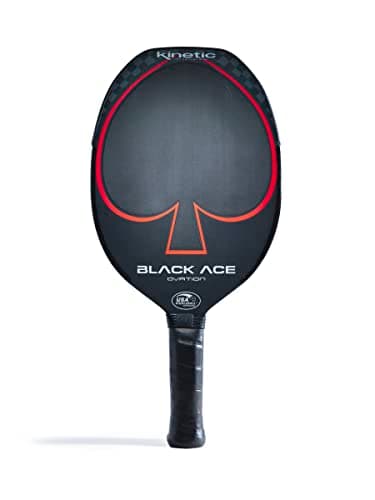
ProKennex Black Ace Ovation— who it is for: the player who wants low mass and low vibration, and the clearest example of a low-swing-weight build we carry. About 7.94 oz on a 16.1 x 7.75-inch outline, with kinetic tungsten-bead damping in both the head and the handle — handle mass is exactly what keeps effective swing weight down. The caveats: the 11mm core is thin, so resets are harder than on a 16mm paddle, and the 4-inch grip is small for most adult hands.
| Surface | Toray 700 carbon fiber |
|---|---|
| Core | 11mm polypropylene honeycomb |
| Dimensions | 16.1 in long x 7.75 in wide |
| Weight | 7.94 oz average |
| Arm comfort | Kinetic tungsten-bead damping in head and handle |
| Grip | 4 in (small) Comfort Pro |
JOOLA Perseus Pro IV 16mm— who it is for: the 3.5-plus player who wants plow-through, reach and stability, and the clearest example of a high-swing-weight build we carry. Elongated, on a Propulsion Core with a stiff Tech Flex Power carbon face and a 5.5-inch handle. The caveats are the honest consequences of that mass distribution: hand speed suffers in fast kitchen exchanges, and the narrower face punishes inconsistent contact.
| Core | Propulsion Core |
|---|---|
| Surface | Tech Flex Power carbon |
| Shape | Elongated |
| Thickness | 16mm |
| Handle | 5.5 in |
| Certification | UPA-A and USAP certified |
The bottom line
Static weight is what the paddle weighs; swing weight is what it feels like; twist weight is what happens when you miss the middle. Shape predicts swing weight better than the scale does, so if you want faster hands, look at shorter and wider paddles rather than just lighter ones — and if you want plow-through, look at elongated.
Before you replace a paddle you otherwise like, spend five dollars on tape. Sides for stability, tip for power, handle to make it swing quicker. It is the only paddle spec you can tune after purchase, and most players never try. If you do want to shop on it, our best lightweight paddles roundup is built around exactly this distinction.
Frequently asked questions
What is swing weight on a pickleball paddle?
Swing weight is how heavy the paddle feels while you swing it - technically its resistance to rotation about the handle. It depends on where the mass sits, not how much there is, so an elongated paddle with mass at the tip can feel heavier in play than a wider paddle that weighs more on a scale. When static weight and swing weight disagree about how a paddle will feel, swing weight is the one that is right.
What is the difference between swing weight and twist weight?
Swing weight is resistance to rotation about the handle and governs hand speed, plow-through and power. Twist weight is resistance to rotation about the paddle's long axis and governs what happens on off-center contact near the edge - high twist weight keeps the face from turning in your hand, so the ball still goes where you aimed. Length drives swing weight; width drives twist weight.
What is a good swing weight for pickleball?
There is no single right number, and no governing body publishes one. Independent testers report most paddles in the low-100s to mid-120s on the tennis kg-cm-squared scale, with the middle of that range being the default most manufacturers target. Choose by symptom: lower if you keep losing hands battles at the kitchen line, higher if your drives land short and off-center balls feel unstable.
Does a heavier paddle always have a higher swing weight?
No, and this is the most useful thing to understand about it. Adding weight at the handle raises static weight while lowering effective swing weight, because it moves the balance point towards your hand. That means a heavier paddle can genuinely swing lighter than a lighter one - and it is why adding a heavier grip is a standard fix for a paddle that feels sluggish.
How do I lower the swing weight of my paddle?
Add mass at the handle rather than removing mass from the head. A heavier replacement grip, an extra overgrip, or a few grams of lead tape wrapped at the base of the handle all shift the balance point towards your hand and make the paddle quicker through a kitchen exchange. Removing an edge guard is not a sensible alternative - it is the paddle's protection and on many modern builds it is structural.
Do manufacturers publish swing weight?
Most do not. Static weight is almost always published, swing weight rarely, and twist weight almost never. The figures that circulate come from independent reviewers using tennis-industry swing-weight machines with their own protocols, which means they are useful for ranking paddles within one tester's data set but not for comparing numbers between sources.
Sources
Keep reading
Upgrading your paddle or gearing up to play?
See how we pick, then dig into the paddle roundups and buying guides — honest picks from someone who actually plays, with no inventory to move.