Comparison Guide
Vatic Pro vs Ronbus: The Value Flagship Question
Both brands sell thermoformed raw-carbon paddles for around a third of what the big names charge, and both have earned genuine cult followings. Here is what actually separates them.
Somewhere around 2023 a group of small, direct-focused paddle brands worked out that the expensive parts of a flagship paddle — thermoformed unibody construction, raw Toray carbon faces, foam-injected perimeters — had become manufacturable at a fraction of flagship prices. Vatic Pro and Ronbus are the two that stuck, and between them they have probably done more to reset expectations of what $100 buys than any major brand has.
If you are here, you have likely already worked out that a $250 paddle is not three times better than a $90 one. The question is which of these two to buy, and it comes down to shape philosophy and how much you value published detail.
Why this comparison exists
Both brands do essentially the same thing: sell a paddle with a raw Toray T700 carbon face and a thermoformed 16mm build, in a small range, at a price the majors do not match. Both have strong word-of-mouth reputations among club players. Neither has meaningful retail presence, pro sponsorship budgets or marketing spend, which is exactly why the paddles cost what they cost.
They are also the paddles most often recommended when someone asks "what should I buy instead of the $250 one?" — a question our best paddles under $100 roundup answers in more general terms.
The short answer
| Vatic Pro | Ronbus | |
|---|---|---|
| Signature build | Thermoformed carbon with foam-injected walls | Thermoformed raw Toray T700 over polypropylene |
| Range logic | Model families (Prism, V-Sol) x face variants (Flash, V7) | Numbered shapes (R1 / R2 / R3) x core spec |
| Shape choice | Fewer options, standard-shape bias | Explicit shape ladder — pick your geometry |
| Typical price | Around $100-110 | Around $40-100 depending on model |
| Extras | Paddle cover included | Long-handle options across the range |
| Best for | One well-sorted all-court paddle | Players who know exactly which shape they want |
What you actually get for the money
Both brands deliver the same three things that used to define a flagship.
A raw carbon face.Unpainted, unsealed Toray T700 weave, which grips the ball for genuine spin rather than relying on a printed texture that wears off. This is the single biggest reason these paddles feel premium — the face is the part you feel most, and it is not where either brand economized. See carbon fiber vs fiberglass.
Thermoformed construction.Rather than gluing a face onto a core inside an edge guard, the paddle is formed as a unibody under heat and pressure. That produces a stiffer frame and a more stable face — the difference is explained in our thermoformed vs cold-pressed guide.
Perimeter stiffening. Vatic Pro injects foam into the walls; Ronbus achieves stability through its thermoformed frame and core spec. Either way, off-center contact holds up better than on a conventionally built paddle.
Shapes and model naming
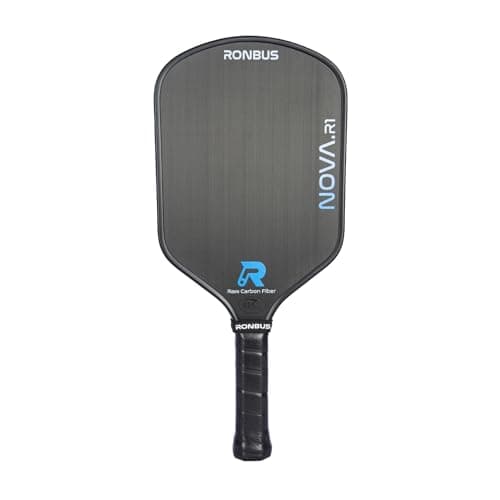
Ronbus names shapes numerically, and this is its most useful feature. The R1 / R2 / R3 designations describe geometry — different head and handle proportions within the same construction — so you choose the shape you want and get the same build underneath. Longer-handle versions are available across the range, which matters if you hit a two-handed backhand. The Pulsar models are the thermoformed budget tier; the R1.16 / R3.16 family is the main line.
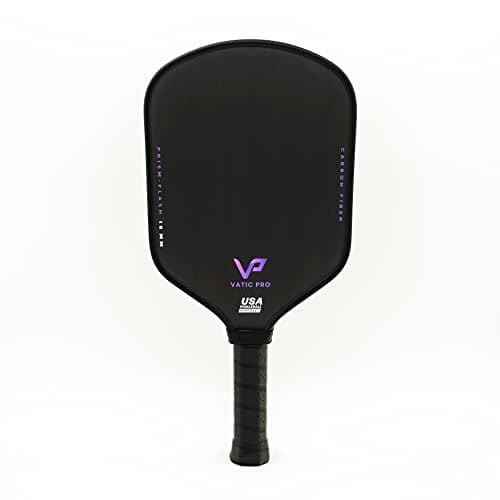
Vatic Pro names model families and face variants.Prism is the core family; V-Sol Pro is the newer foam-core line. Within each, Flash and V7 denote different face and feel tunings — the Flash being the grippier, spin-forward option and the V7 the more balanced one. The range is smaller and skews toward standard-shape all-court paddles.
So the practical difference: Ronbus asks you to know your shape; Vatic Pro asks you to know your feel.If you can answer "do I want an elongated or standard head" confidently, Ronbus gives you more control over the outcome. If you cannot, Vatic Pro's narrower range is the safer path — and our paddle shapes guide will help you answer the question.
The honest trade-offs of buying value
Three things you give up, and they are the same for both brands.
Support depth. Small companies, small support teams. Warranty claims get handled, but the process is an email thread rather than a system. If something goes wrong you are one of hundreds of customers rather than one of hundreds of thousands.
Availability. Popular models sell out and restocks are unpredictable. Neither brand can guarantee that the paddle you liked will be there when you want a second one.
Durability data.Thermoformed paddles as a category have a documented delamination history — covered in our delamination explainer— and neither brand has a decade of field data. Both have been fine in practice for most owners, but "probably fine" is the honest phrasing.
None of that makes either a bad buy. It makes them the right buy for people who would rather own two great $100 paddles over four years than one $250 paddle, and the wrong buy for people who want a single purchase and a corporate warranty behind it.
Which to buy
Vatic Pro Prism Flash 16mm is the one I recommend most often to players who want a single very good paddle and do not want to think about shape theory. Raw carbon, foam walls, standard shape, cover included, around $100. It is the most complete hundred-dollar paddle in the sport and it is a fixture on our best spin paddles list.
Ronbus R1.16 Novais the pick if you want an elongated head with the same construction philosophy — more reach and leverage, a higher sweet spot, and a longer handle. It is the value entry in our best elongated paddles roundup.
If you want to spend less, or want the other tuning from each brand, the second pairing is Vatic Pro's more balanced V7 face against Ronbus's thermoformed budget tier — the Pulsar, which brings the same construction idea down to around forty dollars.
So which one?
For most players, Vatic Pro. The Prism Flash is the more complete package out of the box — foam walls, a cover, a shape that suits the majority of players — and the smaller range means fewer ways to buy the wrong thing. If you have settled on the brand and just need the model, best Vatic Pro paddles ranks the whole lineup and decodes the Prism / V-Sol and Flash / V7 naming.
Choose Ronbus if you know your shape. The numbered range is a genuine advantage for a player who has worked out that they want an elongated head with a 5.5-inch handle, because Ronbus will sell you exactly that in a thermoformed raw-carbon build for less than anyone else will.
And skip both if you need warranty depth or guaranteed availability. In that case a Selkirk SLK Evo Controlat a similar price gives you a major brand's support behind a slightly less exotic paddle — a completely reasonable trade for some people, and the comparison is drawn out in Selkirk vs JOOLA.
Frequently asked questions
Is Vatic Pro or Ronbus better?
They are close, and the choice is about range logic rather than quality. Vatic Pro sells a smaller line of well-sorted standard-shape paddles with foam-injected walls and a cover included, which makes it the safer single purchase. Ronbus names its shapes numerically — R1, R2, R3 — so if you already know the head and handle geometry you want, it gives you more control over what you end up with.
Why are Vatic Pro and Ronbus paddles so cheap?
Not because of cheaper materials. Both use raw Toray T700 carbon faces and thermoformed construction, the same ingredients as flagship paddles. What is absent is pro sponsorship, retail shelf space, national advertising and a large customer-service organization — real costs that the major brands carry and pass on. You are buying the paddle without the marketing apparatus around it.
Are cheap thermoformed paddles durable?
Thermoformed paddles as a category have a documented delamination history, and that applies to expensive ones as much as cheap ones — it is a construction issue, not a price issue. Neither Vatic Pro nor Ronbus has a decade of field data, so the honest answer is that most owners have had no problems and nobody can promise more than that. If you buy one, register it and keep the receipt.
What does the R1 / R2 / R3 numbering mean on Ronbus paddles?
It describes the shape rather than the quality tier. The numbers denote different head and handle proportions within the same construction, so you can pick the geometry you want — including longer-handle versions if you hit a two-handed backhand — and get the same raw carbon thermoformed build underneath. The Pulsar models are the thermoformed budget tier of the same idea.
Should I buy a value paddle or save for a flagship?
For most club players, buy the value paddle. The gap between a good $100 thermoformed raw-carbon paddle and a $250 flagship is real but small, and it lives in margins — off-center stability, face longevity, torsional resistance — that matter most at 4.5-plus. If you are not there yet, spend the difference on court shoes, which reduce injury risk in a way no paddle does.
Sources
Keep reading
Upgrading your paddle or gearing up to play?
See how we pick, then dig into the paddle roundups and buying guides — honest picks from someone who actually plays, with no inventory to move.