Paddle Review
CPX Hyper+ Full Foam Review
Full-foam cores were a $250 idea eighteen months ago. The CPX Hyper+ brings the construction down a tier - which raises the only question that matters with a smaller brand: what did the saving cost?
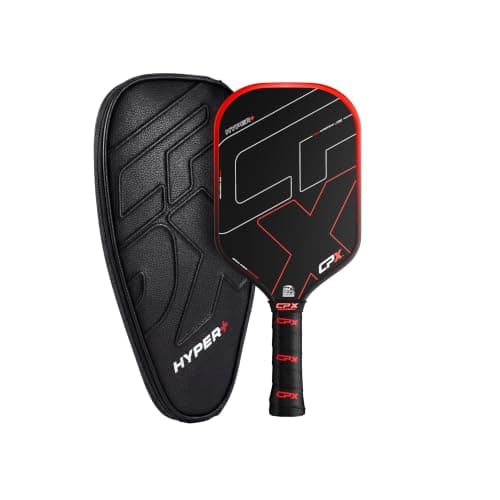
A credible full-foam paddle at a price the established brands have not matched - strong if you want the construction, riskier than buying the same idea from CRBN.
- Best for
- Intermediate and advanced players who want foam-core stability without flagship pricing
- Price context
- Premium tier, below the foam-core flagships
The most significant change in paddle construction in the last three years is not carbon, thermoforming or shape. It is foam— where a manufacturer puts it, how much, and whether it replaces the honeycomb core entirely. The CPX Hyper+ takes the most aggressive version of that idea, a full-foam 16mm core, and sells it below what the established brands charge for the same construction.
This is a research-plus-play review. The construction claims come from CPX's current listing; the on-court notes draw on time with full-foam and foam-walled paddles, which behave consistently enough as a category to describe honestly. Where I am generalizing from the class rather than this exact unit, I say so.
Full foam vs foam walls: not the same thing
Marketing has flattened three quite different constructions into one word. They are not the same and the difference is worth twenty minutes of your attention before you spend $200.
| Construction | What it is | What it does |
|---|---|---|
| Foam-injected walls | Honeycomb core with foam injected around the perimeter | Stiffens the edges; more stable off-center; modest weight gain |
| Foam edge + honeycomb | A foam strip bonded inside the frame | Similar intent, less complete; common on mid-tier paddles |
| Full foam core | The honeycomb is replaced entirely by molded foam | Uniform response across the whole face; the biggest change in feel |
The Hyper+ is in the third row. That matters, because the first two are refinements of a honeycomb paddle and the third is a genuinely different object. Our best Gen 3 paddles roundup and thermoformed vs cold-pressed guide map the whole sequence.
What a foam core actually changes
A honeycomb core is a grid of hollow cells. Its stiffness varies across the face — firmest where the cells are supported by the frame, softest in the open middle. That is why a honeycomb paddle has a "sweet spot": a region where the response is best, surrounded by regions where it is worse.
A molded foam core does not have that structure. Its response is far more uniform from the center to the edges, which is why full-foam paddles are described as having enormous sweet spots. That is slightly misleading — it is not that the good area is larger, it is that there is less difference between the good area and the rest.
How it plays
Off-center contact holds up. This is the thing foam cores genuinely deliver and the reason the category exists. A ball caught out toward the edge keeps far more of its speed and direction than it would on a honeycomb paddle. In fast hands battles, where a lot of contact is not clean, that is a real advantage rather than a spec-sheet one.
16mm keeps it sane. Foam construction at 14mm produces some genuinely brutal paddles. At 16mm, the extra thickness gives back some compression and control, which makes the Hyper+ a paddle you can play a soft game with rather than one that fires every reset into the net. If you are choosing thickness generally, our 14mm vs 16mm guide covers it.
It is firm.Not harsh, but firm — the trade every foam paddle makes. Coming from a polymer-core paddle you will notice more of each impact arriving at your hand, and you will want to hold the grip a little more loosely than you think.
The honest risk with a smaller brand
Two risks, and neither is a reason not to buy — they are reasons to buy with eyes open.
Support depth. CPX publishes less specification detail than the majors and has a smaller warranty and resale footprint. If a paddle develops a problem in month four, the difference between a big brand and a small one is the difference between a form and an email thread.
Category-wide durability.This is not specific to CPX. Full-foam cores are new enough that nobody has a decade of data on how they age, and the industry has already lived through one durability reckoning with thermoformed paddles delaminating — covered in our delamination explainer. Buying any full-foam paddle right now is buying into a construction that is still proving itself, whoever makes it.
Who it's for (and who should skip it)
Buy it if you specifically want full-foam construction, you play at a level where off-center stability changes outcomes, and the price gap against CRBN and the other established foam paddles is what has been stopping you. It is a legitimate way into the category.
Skip it ifyou have an elbow you are managing, if you want the deepest possible support behind a $200 purchase, or if you are not yet at a level where mis-hit behavior is what limits you. Below about 4.0, a good 16mm polymer paddle will do more for your game and cost half as much — see best paddles under $100.
How it compares
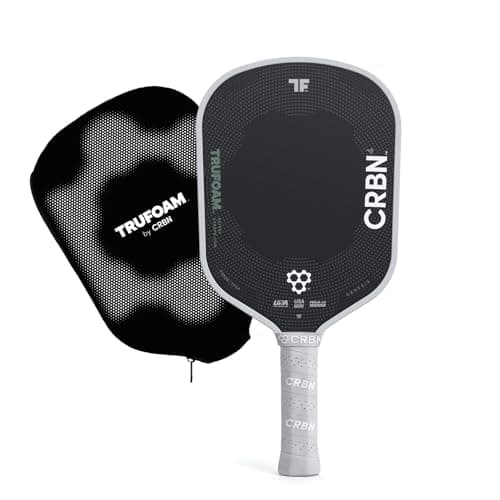
The obvious comparison is the CRBN TruFoam Genesis, which is the reference full-foam paddle and the one every other foam paddle is measured against. CRBN has the deeper track record and the more documented build; CPX has the price. Against foam-walled Gen 3 paddleslike the Konvoi Fleet or the Enhance Duo, the Hyper+ is the more thorough version of the same idea — foam everywhere rather than foam at the edges.
Verdict
The Hyper+ does what a full-foam paddle should do: it makes imperfect contact behave much more like perfect contact, and at 16mm it does that without becoming a paddle you cannot reset with. Getting that construction below flagship pricing is genuinely useful, and if the price gap is what has kept you out of the category, this closes it. The caveats are honest ones — a smaller brand behind the warranty, thinner published specs, and a construction the whole industry is still learning about. Buy it because you want a full-foam paddle. Do not buy it as your first serious paddle.
What we liked
- Genuine full-foam core, not a foam-walled honeycomb paddle
- 16mm thickness keeps it forgiving rather than purely aggressive
- Meaningfully cheaper than the established full-foam flagships
- Foam construction delivers the off-center stability it promises
What gave us pause
- Small brand: thin published specs, limited warranty and resale support
- Full-foam durability across the whole category is still an open question
- Firmer than a polymer-core paddle, so arm comfort is a real consideration
Frequently asked questions
What is a full-foam pickleball paddle core?
It is a core where molded foam replaces the polymer honeycomb entirely, rather than being injected around a honeycomb core's perimeter. Because foam does not have the honeycomb's varying cell support, its response is far more uniform from the middle of the face out to the edges — which is why full-foam paddles are described as having enormous sweet spots.
Is a foam core paddle better than honeycomb?
It is better at one specific thing: keeping off-center contact predictable. A ball caught near the edge retains more speed and direction than it would on a honeycomb paddle. It is not better at comfort — foam cores are generally firmer than polymer honeycomb, so more impact reaches your arm — and it is not better value, since foam construction costs more to make.
Are full-foam paddles durable?
Nobody has a decade of data yet, and that is the honest answer for the whole category rather than any one brand. Full-foam construction is only a few years old, and the industry has already lived through one durability reckoning with thermoformed paddles delaminating. Buying any full-foam paddle today means buying into a construction that is still proving itself.
Is the CPX Hyper+ good for beginners?
No. It is a firm, premium-construction paddle built to solve a problem — inconsistent off-center contact costing you points — that beginners are not yet at the level to notice. A forgiving 16mm polymer-core paddle at half the price will teach the soft game faster and be far kinder to your arm.
CPX Hyper+ or CRBN TruFoam Genesis?
The CRBN is the reference paddle in this category, with the deeper track record, more documented construction and stronger support network. The CPX offers the same fundamental idea for meaningfully less money. If the price gap is what has kept you out of full-foam paddles, the CPX is a legitimate route in; if you want the safest version of the purchase, the CRBN is still the benchmark.
Sources
Keep reading
Upgrading your paddle or gearing up to play?
See how we pick, then dig into the paddle roundups and buying guides — honest picks from someone who actually plays, with no inventory to move.