Blog
What Paddle Do the Pros Use?
The honest answer is more interesting than a list of models: the paddle a pro plays is usually a customized version of one you can buy, chosen for reasons that have very little to do with your Tuesday-night doubles.
It is one of the most-asked questions in the sport, and most answers to it are a list of names and models scraped from sponsorship announcements. That list goes out of date within a season, and more importantly it does not tell you the thing you actually wanted to know: whether buying it would help.
So here is the more useful version. What the top players are sponsored by is public and easy to establish — the signature lines are literally named after them. What they physically hold on court is a different and more interesting object.
The short answer
At the top of the game, most pros play a signature or flagship model from the brand that sponsors them, almost always modified: weighted with lead tape, re-gripped, and frequently a pre-production or specification-controlled version of the retail paddle.
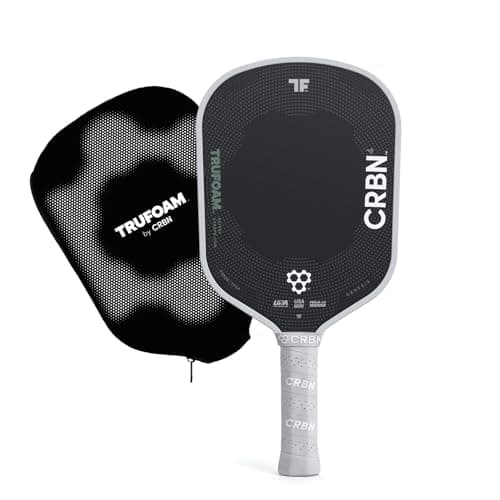
The brands with the most visible pro presence in pickleball are JOOLA, Selkirk, CRBN, Paddletek, Engage, Gearbox and Six Zero — and JOOLA in particular built its pickleball business around named signature lines, which is why its catalog reads like a player roster.
Signature models: what they really are
A signature paddle is a real product with a real athlete's input, and it is also a marketing instrument. Both things are true.
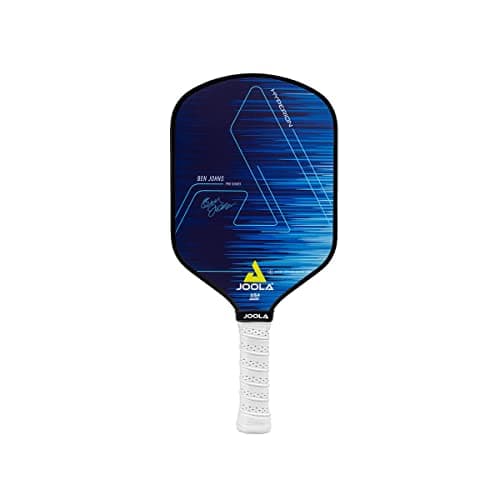
You can see this most clearly in JOOLA's range, where the lines carry the names outright: the Perseus and Hyperion families are Ben Johns', the Scorpeusis Collin Johns', and there are Anna Bright and Andre Agassi models in the current catalog. Those paddles genuinely reflect the player's preferences — Collin Johns is a touch-and-counter player and the Scorpeus is tuned accordingly, which is exactly why it shows up in our best paddles for tennis elbow roundup rather than the power one.
What a signature model is notis a copy of the object in the pro's hand. Retail production has tolerances; a sponsored player's paddles are selected and set up. That gap is normal in every racket sport and it is not a scandal — it is just worth knowing before you spend $250 expecting to hold what you watched on the broadcast.
What pros actually change
Four modifications are close to universal at the top level, and three of them are available to you for under twenty dollars.
| Modification | Why they do it | Can you? |
|---|---|---|
| Lead tape at 3 and 9 o'clock | Raises twist resistance so the head turns less on off-center hits | Yes — a few dollars |
| A specific grip build-up | Grip size and shape are personal and rarely right off the shelf | Yes — overgrips |
| Weight matching across paddles | Every paddle in the bag plays identically, so a mid-match swap changes nothing | Yes, with a kitchen scale |
| Specification-controlled units | Tighter tolerances than retail production | No — this one is not available to you |
The first three are genuinely worth copying and are covered in our lead tape guide, grip size guide and best overgrips roundup. Weight-matching a second paddle to your main one is the single most professional thing you can do to your bag, and it costs nothing but a scale and some tape.
Why a pro chose that paddle
This is the part that makes the whole question less useful than it sounds. A professional's paddle choice is made under constraints you do not have.
Sponsorship.The most obvious one. A sponsored player plays their sponsor's paddle. That does not mean they dislike it — brands and players are usually matched sensibly — but the choice was not made from the whole market.
A different game. Pros hit harder, move faster, and make clean contact vastly more often than the rest of us. A paddle with a small, demanding sweet spot costs them almost nothing and costs you a great deal. Forgiveness is a feature they can afford to trade away.
Different failure modes.At the top level, points are lost to a ball that sat up two inches too high. Torsional stability and face-grit longevity are worth real money in that context. At 3.5, points are lost to shots that miss the paddle's middle entirely, and a bigger sweet spot solves more of those than a stiffer frame does — which is the argument behind our best widebody paddles roundup.
Should you buy a pro's paddle?
If you are 4.5 or above:reasonably, yes. At that level the things flagship paddles do better — stability under imperfect contact, a face that keeps its bite through a tournament, precise core tuning — are things you will actually use. The paddles in our best paddles for advanced players roundup are chosen on exactly that basis.
If you are 3.5 or below:honestly, no. A signature flagship is optimized for a player whose problems are not your problems, and several of them are actively harder to play with than a good $100 paddle — smaller effective sweet spots, firmer feel, less forgiveness. The argument is laid out in do expensive paddles play better.
If you just want it: that is a completely legitimate reason and I am not going to pretend otherwise. Wanting the nice thing is allowed. Just buy it knowing it is the reason, rather than expecting a rating point that is not in the box.
What is worth copying
If the real question behind "what paddle do the pros use" is "what are they doing that I could do", the answer is not the paddle.
They carry more than one, matched. A second paddle set up identically to the first means a broken paddle or a delamination mid-tournament changes nothing.
They keep the face clean.A raw carbon face loses its grit to dust and skin oil long before it wears out. Pros wipe paddles constantly. Most recreational players never do, then conclude the paddle stopped spinning — see paddle care and cleaning.
They replace grips on a schedule.Not when it disintegrates — on a schedule, because a slick grip makes you squeeze, and squeezing wrecks touch.
They wear court shoes.Every single one of them, every single time. It is the least glamorous thing on this list and the one that will do the most for the average reader — our best pickleball shoes roundup covers it.
If you want one anyway
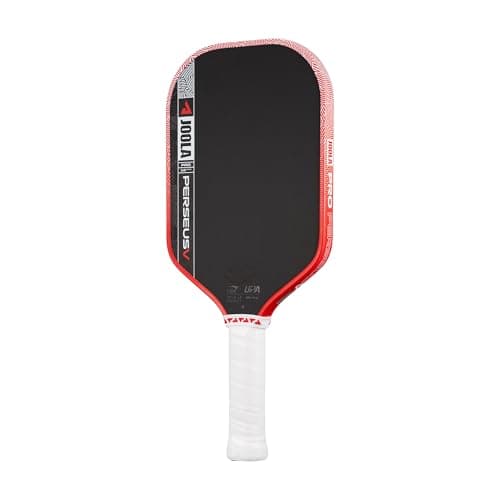
The two most visible signature flagships you can actually buy are Ben Johns' Perseus Pro IV and Collin Johns' Scorpeus Pro IV — the power-and-reach paddle and the touch-and-counter paddle respectively. They are genuinely excellent, and they are genuinely more demanding than what most readers of this site should be playing with.
The third pick is the honest counterweight: the Vatic Pro Prism Flash costs around a third as much, has the same fundamental construction ideas, and will out-perform either of them in the hands of a player who has not yet dialed in contact.
Full write-ups: the JOOLA Perseus Pro IV review, the JOOLA Pro V reviewfor the brand's non-signature flagship, and the Vatic Pro Prism Flash review.
Frequently asked questions
What paddle does Ben Johns use?
Ben Johns is JOOLA's signature athlete and the Perseus and Hyperion lines carry his name, so the paddles he plays come from that family. As with every top professional, the physical paddle he uses is customized — typically weighted with lead tape, re-gripped and specification-controlled — rather than being a stock retail unit off the shelf. Sponsorships and models also change between seasons, so treat any specific model claim as a snapshot.
Do pros use the same paddles you can buy?
The same models, usually not the same objects. A sponsored player's paddles are selected and set up: weighted with lead tape at the sides for twist resistance, built up to a personal grip size, weight-matched to each other, and often pre-production or tolerance-controlled versions. That gap is normal in every racket sport, and the customizations are mostly things you can do yourself for under twenty dollars.
Should I buy the same paddle a pro uses?
If you play at 4.5 or above, it is a reasonable purchase — the things flagships genuinely do better are things you will use. Below about 3.5, it is usually the wrong buy: signature flagships are optimized for players who make clean contact almost every time, so they trade away the forgiveness that helps you most. A good $100 paddle will produce better results for most recreational players.
What brands do most pickleball pros play?
The brands with the most visible professional presence are JOOLA, Selkirk, CRBN, Paddletek, Engage, Gearbox and Six Zero. JOOLA in particular built its pickleball business around named signature lines, which is why its catalog reads like a player roster. Rosters change between seasons, so any specific list has a short shelf life.
What do pros do to their paddles?
Four things, three of which you can copy. They add lead tape at the sides to raise twist resistance, build the grip up to a personal size and shape, and weight-match every paddle in the bag so a mid-match swap changes nothing. The fourth — playing specification-controlled units with tighter tolerances than retail production — is not available to the rest of us.
Sources
Keep reading
Upgrading your paddle or gearing up to play?
See how we pick, then dig into the paddle roundups and buying guides — honest picks from someone who actually plays, with no inventory to move.