Buying Guide
How to Choose Pickleball Shoes
Your paddle decides how well you play. Your shoes decide whether you're still playing in six months. This is the one purchase in pickleball where getting it wrong is an injury risk, not a preference.
Ask a group of experienced players what they wish they'd bought first and a surprising number will say shoes. Not because court shoes are exciting — they aren't — but because the ankle injuries that end people's pickleball are almost entirely preventable, and the prevention costs less than a mid-range paddle.
This guide covers the decision from scratch: why the shoes you already own are the wrong ones, what actually distinguishes a court shoe, and how to check fit properly.
Why running shoes are the problem
Running shoes are superb at what they were designed for, and that design is actively wrong for pickleball. Three specific reasons:
The midsole is tall and soft on purpose.Running shoes maximize cushioning for repeated forward impact, which means a high stack of compliant foam between your foot and the ground. That stack is deliberately unstable sideways. When you push hard laterally, your foot rolls over the edge of it — and that is how ankles turn.
The outsole only grips forward.Running tread patterns are optimized for straight-line traction. Ask them for sideways grip and they skid, which is a slip risk in exactly the moments you're least ready for it.
The upper isn't built to hold you. Running uppers are soft and accommodating because your foot moves forward in them, not sideways. In a lateral push your foot slides across the footbed inside the shoe.
What makes a court shoe
A low, firm, wide platform. Less foam, denser foam, and a wider base than the upper. Your foot sits closer to the ground and has less leverage to roll.
A multi-directional outsole. Herringbone or gum patterns grip in every direction and allow a controlled slide rather than a sudden catch. Catching is what tears things.
A reinforced upper and a firm heel counter.The upper is built to resist lateral shear. The heel counter — the stiff cup around your heel — controls how much your rearfoot rolls. Squeeze it in the shop: if it collapses between your fingers, it will collapse under you.
Toe drag protection. Pickleball wears the outer toe of your dominant-side shoe faster than anything else, from pushing off and sliding into wide dinks. Court shoes armor that spot; running shoes wear through it in weeks.
Often, an outsole durability warranty. Many court shoes carry one. It tells you the manufacturer expects the outsole to be the thing that wears out, which is correct.
Tennis, volleyball and badminton shoes all satisfy these criteria — a good tennis shoe beats a mediocre pickleball-branded one. Our best pickleball shoes roundup has the shortlist.
Indoor vs outdoor outsoles
This is the choice most people get wrong, and it comes down to rubber compound.
| Indoor court shoes | Outdoor court shoes | |
|---|---|---|
| Outsole | Soft gum rubber | Harder herringbone rubber |
| Surface | Polished wood, sport court | Concrete, asphalt, hard court |
| Grip | Excellent on smooth floors | Excellent on abrasive surfaces |
| Marking | Non-marking (required in most gyms) | Usually non-marking too |
| Used on the wrong surface | Wears away rapidly outdoors | Grips adequately but less indoors |
The practical rule: if you play both, buy outdoor. A harder outdoor outsole survives indoors with slightly less grip. A soft gum outsole outdoors disappears in weeks. Asymmetric consequences, so pick the direction that fails gracefully.
If you play indoors exclusively, a volleyball or badminton shoe is an excellent and often cheaper option — both are built for exactly the same explosive lateral movement on the same surfaces. Our best indoor pickleball shoes roundup ranks those options specifically, and our women's shoes roundup includes one for the same reason.
The two-minute fit check
1. Try them late in the day. Feet swell over the course of a day and swell further during play. A shoe fitted at 9am can be tight by evening.
2. Wear the socks you play in. Sock thickness moves fit by half a size, and most people try shoes in whatever they wore to the shop.
3. Check the heel first.Lace them properly and walk. If your heel lifts, the shoe is wrong — no amount of lacing tricks makes an ill-fitting heel safe, and a heel that slides during a lateral push means the shoe isn't supporting you at the moment you need it.
4. Thumb's width at the toe.Roughly a thumb's width between your longest toe and the end. Court shoes stop hard, and your toes go forward when they do.
5. Do a lateral push in the shop. Plant and push sideways as if reaching for a wide dink. Your foot should stay on the footbed, not slide toward the edge. This is the test that actually matters and almost nobody does it.
6. Accept that court shoes feel snug.They're cut narrower than running shoes on purpose — that snugness is the support. Snug is right; painful is not.
Wide feet, arch pain and other cases
Wide feet.Don't size up in length to gain width — that leaves your heel loose and your toes sliding on stops, which is worse than the original problem. Buy a wide-specific model. Several brands make genuinely wide court shoes.
Plantar fasciitis or arch pain.The temptation is a soft, cushioned running shoe, which trades heel pain for an ankle sprain. What you want instead is a court shoe with genuine arch support — a contoured footbed rather than just thick foam. Our arch-support roundup covers the options, including the insole question.
Ankle history.Prioritize a firm heel counter and a low platform over cushioning, and consider a slightly heavier stability shoe — it holds its structure longer, which matters because support fades invisibly as a shoe ages.
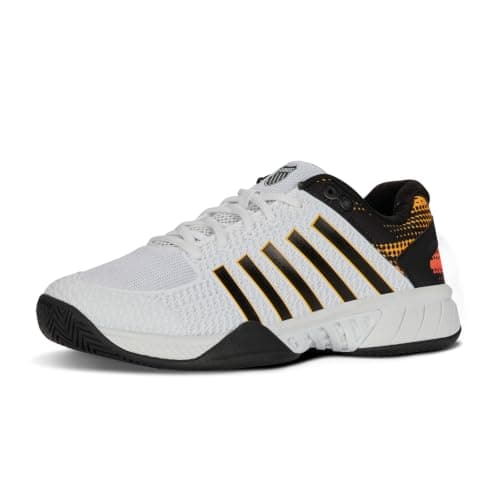
Long sessions. Weight underfoot accumulates into fatigue, and a fatigued foot loads badly. A lighter court shoe like the K-Swiss Express Light is a reasonable trade if your sessions run three hours.
When to replace them
Don't judge by time or by how the upper looks. Check four things:
The outsole under the ball of your foot.If the tread has worn smooth at your pivot point — usually the paddle-side foot — the shoe can no longer grip reliably in lateral movement. This is the clearest signal and the most dangerous to ignore.
The heel counter. Squeeze it. If it now collapses easily, the support is gone.
The midsole. Press it and compare to a new shoe if you can. A packed-out midsole feels dead and no longer absorbs what it was built to absorb.
The outer toe. Wear there is normal in this sport. Wear through into the upper means the shoe is finished.
The unsettling part is that midsoles and heel counters fail invisibly. A shoe that looks fine can have stopped supporting you months ago. That is the argument for a durable stability shoe like the Babolat SFX 4 if you play often.
For the replacement intervals by how many times a week you play — and why outdoor concrete roughly halves them — see how long pickleball shoes last.
How much to spend
The first jump matters most. Moving from running shoes to any real court shoe removes the majority of the risk. A budget tennis shoe does that. If money is tight, buy the cheapest genuine court shoe rather than delaying until you can afford a better one.
Above that, you're buying durability and comfort.More money gets you better cushioning, better materials and a shoe that keeps its structure longer — real benefits, but incremental compared with the first step.
Last year's model is the best value in gear. Court shoe designs change slowly, and the previous generation of a good shoe is frequently half the price of the current one and 95% of the shoe.
Spend here before you spend on a paddle upgrade.A better paddle makes you play slightly better. Better shoes keep you playing. If you're choosing between them, it isn't close — and the beginner gear guide puts the whole kit in order.
And you probably do not need a pickleball-branded shoe.Tennis shoes are court shoes, and often cheaper for the same construction — pickleball shoes vs tennis shoes sets out the four things the pickleball-specific shelf genuinely does better. If comfort is what is driving the purchase, start instead with the most comfortable pickleball shoes.
Frequently asked questions
Can I wear running shoes for pickleball?
You shouldn't. Running shoes have tall, soft midsoles designed to be efficient forward and deliberately unstable sideways, outsoles that grip only in a straight line, and uppers that don't hold your foot laterally. Pickleball is almost entirely side-to-side movement with abrupt stops, so running shoes are the leading cause of rolled ankles on court.
Are tennis shoes okay for pickleball?
Yes — tennis and pickleball demand the same things from footwear: a low, stable platform, a multi-directional court outsole, a firm heel counter and toe-drag reinforcement. A good tennis shoe beats a mediocre pickleball-branded one. Volleyball and badminton shoes also work well, particularly indoors.
What's the difference between indoor and outdoor pickleball shoes?
The outsole rubber. Indoor shoes use soft gum rubber that grips polished wood without marking it but wears away quickly on abrasive surfaces. Outdoor shoes use harder herringbone rubber built to survive concrete and asphalt. If you play both, buy outdoor — it survives indoors with slightly less grip, whereas gum outsoles disappear outdoors in weeks.
How should pickleball shoes fit?
Snug through the midfoot with a locked-down heel and about a thumb's width at the toe. Court shoes are cut narrower than running shoes on purpose — that snugness is the support. Try them late in the day in the socks you play in, and do a lateral push in the shop: your foot should stay on the footbed rather than sliding toward the edge.
How often should you replace pickleball shoes?
Judge by condition rather than time. Replace when the outsole tread has worn smooth under the ball of your foot, when the heel counter collapses easily under a squeeze, when the midsole feels dead compared with a new shoe, or when the outer toe has worn through into the upper. Midsoles and heel counters fail invisibly, so check them deliberately.
Sources
Keep reading
Upgrading your paddle or gearing up to play?
See how we pick, then dig into the paddle roundups and buying guides — honest picks from someone who actually plays, with no inventory to move.