Buying Guide
Pickleball Paddle Handle Length, Explained
Handle length is the spec that decides whether a two-handed backhand fits, and it is the one paddle dimension you cannot adjust after you buy. Here is what the numbers mean and which one you want.
The short answer
Handle length is how much of the paddle you can actually hold, measured from the butt cap to where the face begins. Most paddles sit between about 5.0 and 5.5 inches. The decision is simple to state: if you hit a two-handed backhand, or want the option, you need about 5.5 inches or more. If you do not, a shorter handle gives that length back to the face, where it becomes sweet spot.
That is the whole trade. A paddle's total length is capped, so every extra half-inch of handle is a half-inch of hitting surface you gave away. Manufacturers are not being stingy with handle length — they are spending a fixed budget.
It is also the one dimension you are stuck with. Grip circumference you can build up with an overgrip in two minutes; weight you can change with a few grams of tape. Handle length is decided at the factory, which is why it deserves more attention than it usually gets when people shop.
Three numbers people confuse
Paddle listings quote several measurements in inches and they are not interchangeable. These are the three that matter, and mixing them up is the most common reason someone buys a paddle that does not fit their game.
| Number | What it measures | Typical range | Can you change it? |
|---|---|---|---|
| Handle length | Butt cap to the start of the face - how much you can hold | About 4.75 to 5.75 in | No |
| Grip circumference | The distance around the handle - how thick it feels | About 4 to 4.25 in | Yes, build it up with an overgrip |
| Paddle length | Total butt cap to tip, handle plus face | Up to 17 in by rule | No |
Handle length is the subject of this page. It decides whether two hands fit and how much leverage your bottom hand has.
Grip circumference is a completely different problem with a completely different solution. A 4-inch grip that feels too thin becomes a 4.0625-inch grip with one overgrip, so circumference should almost never rule a paddle out. Our pickleball grip size guide covers how to measure your hand and what to do about it.
Paddle length is the total, and it is where the constraint comes from. USA Pickleball caps combined length plus width at 24 inches with a separate maximum length of 17 inches, which is why no legal paddle can simply add handle without taking it from somewhere. The full certification picture is on what USA Pickleball approved actually means.
Why a long handle costs you face
Work the arithmetic and the trade-off becomes concrete. Take an elongated paddle at the 16.5-inch length most flagships use. Give it a 5.5-inch handle and roughly 11 inches are left for the head. Shorten the handle to 4.75 inches and the head grows to about 11.75 inches of usable length — three quarters of an inch of extra hitting surface, almost all of it at the top of the face where put-aways and overheads land.
That is not a rounding error. The top of the face is the region most players mis-hit toward, and the paddles with the biggest tolerance for a high contact point are, reliably, the ones with shorter handles. It is why widebody paddles — the most forgiving shape in the sport — almost always pair a wide face with a short handle, and why elongated paddles with long handles are the least forgiving combination you can buy.
The ranges and what they feel like
There is no official classification, and makers do not agree on where “long” starts. These are the bands as the market actually uses them, given as bands rather than thresholds because a tenth of an inch either side changes nothing.
| About 4.75 to 5.0 in (short) | One-handed play only. Maximum face area and the biggest sweet spot for the shape. Common on widebody and quad-head paddles. |
|---|---|
| About 5.0 to 5.3 in (standard) | The default. A two-handed backhand is cramped but possible for smaller hands. Balanced face area. |
| About 5.5 in (long) | A genuine two-handed backhand fits without the bottom hand hanging off the butt cap. The most common flagship spec. |
| About 5.6 to 5.75 in (extra long) | Comfortable two-handed play and the most leverage. Noticeably less head length - the least forgiving option. |
Two practical notes. First, the number is measured to the start of the face, but what you feel is how much room there is aboveyour dominant hand — so a long handle on a paddle with a thick throat can still feel cramped. Second, hand size changes the whole scale: a player with small hands can get two hands onto a 5.3-inch handle that a large-handed player cannot use at all.
Who needs a long handle
Anyone who hits a two-handed backhand.This is the only reason that is not a preference. If your bottom hand cannot get on the handle without hanging off the butt cap, the shot does not work, and no amount of technique fixes a handle that is too short. If you are not sure whether you want the shot, buy the length that allows it — you can play one-handed on a long handle, but you cannot play two-handed on a short one.
Tennis and racquetball converts. A long handle makes a swing that came from a racquet feel natural instead of stubby, and it gives the bottom hand somewhere to go on topspin drives. Our best paddles for tennis players roundup screens on exactly this spec, and every pick on it carries at least 5.25 inches.
Tall players and players with large hands.Not because of reach — total paddle length governs reach, not handle length — but because a 5-inch handle in a large hand leaves the heel of the palm on the butt cap, which is an unstable place to hold a paddle from. Our best paddles for men page treats handle length as one of the three specs that actually differ by build.
Players who like to choke up. If you move your hand up the handle for touch shots and back down for drives, you need the room to do it.
Who needs a short handle
One-handed players who mis-hit. If you have never considered a two-handed backhand and you are still finding the middle of the face, a short handle is free forgiveness. The length goes into the head, the sweet spot grows, and you lose nothing you were using.
Kitchen-line specialists. Most recreational doubles points are decided in dinks, blocks and speed-ups, and in those exchanges face area and hand speed beat leverage. See best paddles for doubles and best widebody paddles, which is where the short handles live.
Players with shoulder or elbow issues.A shorter handle usually means a shorter overall paddle and less mass out at the tip, which lowers swing weight. That is the direction you want if your arm hurts — see best paddles for tennis elbow.
Anyone upgrading from a starter set. Entry paddles are usually short-handled widebodies, and the honest advice is that a long handle only helps if you have a shot that needs it. Buying a 5.75-inch handle because the flagship paddles have one is how players end up with less face and no new shots.
Handle length and swing weight
There is a counter-intuitive interaction worth knowing. Handle length does not just change where your hands go — it changes where the paddle's mass sits relative to them.
A longer handle means more of the paddle's material is behind your hand rather than in front of it. Mass behind the hand raises static weight while lowering effective swing weight, because swing weight measures resistance to rotation about the handle. So a long-handled paddle can weigh more on a scale and still feel quicker through a hands battle than a shorter-handled paddle of the same weight whose mass sits out at the tip.
This is why two paddles with identical published weights can feel nothing alike, and why handle length belongs in the conversation alongside weight rather than after it. Our swing weight guide works through the three weight numbers, paddle weight covers choosing a static weight band, and the best heavy paddles and best lightweight paddles roundups shop the two ends of it.
The spec you cannot change
Almost everything about a paddle is adjustable after purchase. Grip circumference goes up with an overgrip — see best pickleball overgrips. Weight and balance change with a few grams of tape, covered in our lead tape guide. Face texture you cannot legally modify but you can clean, which our paddle care guide covers.
Handle length is the exception. You cannot lengthen a handle, and shortening one destroys the paddle. There is no aftermarket fix and no technique workaround. That asymmetry is the practical argument for erring long if you are genuinely undecided: a long handle costs you some face area you might not miss, while a short handle can permanently rule out a shot you later want to learn.
It is also the reason to check the number rather than the marketing. “Elongated” describes the head shape, not the handle, and plenty of elongated paddles ship with standard 5-inch handles. “Long handle” as a product name means nothing without an inch figure next to it. If a listing does not publish handle length, treat that as a missing spec rather than an unimportant one.
What to buy
Three paddles we carry, picked to show the three positions on this spectrum rather than to rank them against each other. All three were verified in stock with a live Amazon price when this page was written.
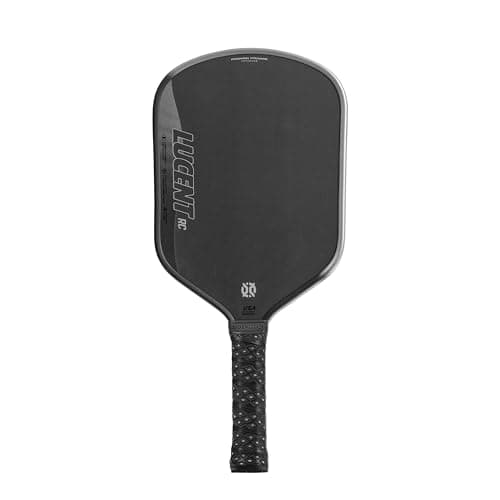
Onix Lucent RC— who it is for: the player who wants the longest handle we carry on a modern paddle. At 5.7 inches there is genuine room for a second hand, on a raw carbon face and a 14mm core. The caveats are real: elongated plus a thin core plus a long handle is the least forgiving combination in this guide, so the sweet spot sits higher and narrower than on a widebody, and the 4.125-inch grip is on the thicker side before you add anything.
| Handle | 5.7 in, 4.125 in grip circumference |
|---|---|
| Face | Dual Action raw carbon fiber |
| Core | Hexcell polypropylene, 14mm |
| Shape | Elongated, 16.5 in long x 7.5 in wide |
| Weight | 7.75-8.25 oz |
| USA Pickleball | Approved |
Vatic Pro Prism Flash 16mm— who it is for: anyone who wants to make this decision deliberately. Vatic sells the same paddle in a Standard 5.3-inch and a Long 5.75-inch handle, so you can choose the compromise instead of accepting whichever one the brand built. The build underneath is raw Toray T700 carbon over a 16mm core with foam-injected walls. The caveat is that the two versions are separate listings and stock on them moves independently, so confirm which handle you are adding to the cart before you check out.
| Handle | Standard 5.3 in or Long 5.75 in; 4.125 in grip circumference |
|---|---|
| Surface | Raw Toray T700 carbon fiber, heat-compressed texturing |
| Core | 16mm (a 14mm version is also sold) with foam-injected walls |
| Shape | Elongated - 16.2 in x 7.7 in |
| Weight | About 7.9 - 8.2 oz (16mm); 7.7 - 7.9 oz (14mm) |
| Certification | USA Pickleball approved |
Gearbox G14 Quad— who it is for: the one-handed player who would rather have the face than the handle. A 4.75-inch handleis the shortest we carry, and Gearbox spends the difference on an 11.125-inch head length inside a 15.875 by 7.875-inch outline — wide and long at the same time, which is why the sweet spot is among the biggest on this site. The caveats: two-handed play is genuinely out, the 4-inch grip is small for large hands, and Gearbox does not state USA Pickleball approval on its own spec sheet for this model, so verify before sanctioned play.
| Handle | 4.75 in; 4 in grip |
|---|---|
| Surface | 8-ply Toray T-700 / mid-modulus carbon, raw textured |
| Core | 14mm polypropylene honeycomb |
| Dimensions | 15.875 x 7.875 in; 11.125 in head length |
| Weight | 7.6 - 8.0 oz |
| Certification | Not stated on Gearbox's spec sheet - verify before sanctioned play |
The bottom line
Decide the two-handed backhand question first, because it answers everything else. If you hit the shot or want the option, buy about 5.5 inches or more and accept a slightly smaller sweet spot. If you do not, buy 5.0 inches or less and bank the extra face area — it is free forgiveness you are otherwise throwing away for a shot you never play.
Then check the number rather than the shape name, remember that grip circumference is a separate and fixable problem, and keep in mind that handle length is the one paddle spec no overgrip, tape or technique can change later. If you are still narrowing things down, start with how to choose a pickleball paddle, and paddle shapes explained covers what the rest of the outline is doing while the handle gets all the attention.
Frequently asked questions
What is a standard pickleball paddle handle length?
About 5.0 to 5.3 inches is the standard band, measured from the butt cap to where the face begins. Shorter handles run to about 4.75 inches, usually on widebody paddles that spend the difference on face area, and long handles sit at about 5.5 inches and up, which is the flagship norm because that is where a two-handed backhand starts to fit.
What handle length do I need for a two-handed backhand?
About 5.5 inches or more. Below that, the bottom hand ends up partly on the butt cap, which is unstable and limits how much the hand can contribute to the shot. Players with smaller hands can sometimes manage on a 5.3-inch handle. If you are undecided, buy the longer handle - you can always play one-handed on it, but you cannot play two-handed on a short handle.
Does a longer handle mean more reach?
No. Reach comes from total paddle length, which is capped at 17 inches by rule, and a longer handle takes that length from the head rather than adding to the paddle. An elongated paddle with a short handle actually puts more hitting surface further from your hand than the same length paddle with a long handle does.
Is handle length the same as grip size?
No, and conflating them is the most common mistake in paddle shopping. Handle length is how long the handle is (roughly 4.75 to 5.75 inches). Grip size, or grip circumference, is the distance around it (roughly 4 to 4.25 inches) and determines how thick it feels. Circumference you can increase with an overgrip in two minutes; length is fixed at the factory.
Can you change a pickleball paddle's handle length?
No. There is no aftermarket way to lengthen a handle, and cutting one down destroys the paddle and voids its certification. This is the one paddle dimension you cannot adjust after you buy, which is why it is worth checking the published figure rather than assuming it from the shape name.
Does a long handle lower swing weight?
It can, which surprises people. A longer handle puts more of the paddle's mass behind your hand, and swing weight measures resistance to rotation about the handle - so mass behind the hand raises static weight while lowering effective swing weight. A long-handled paddle can weigh more on a scale and still feel quicker through a fast exchange than a tip-heavy paddle of the same weight.
Sources
Keep reading
Upgrading your paddle or gearing up to play?
See how we pick, then dig into the paddle roundups and buying guides — honest picks from someone who actually plays, with no inventory to move.