Paddle Review
Pikkl Hurricane Pro Review
A thermoformed T700 carbon paddle with a urethane foam perimeter and a 5.5 inch handle, from a Minnesota brand three years old. The spec sheet reads like a $250 paddle. The small print does not.
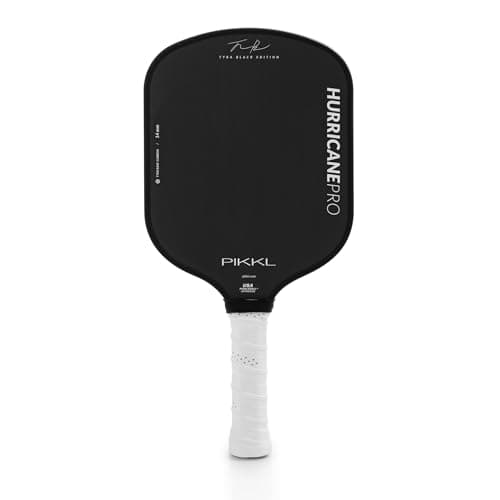
Genuinely current construction at a fair price, held back by a small brand's warranty, a ten-day return window and no published tournament approval.
- Best for
- Spin-first 3.5 to 4.5 players who add lead tape
- Price context
- Upper-mid tier
Two Pikkl queries land on this site every month and we have never had a page to answer them, so here is the answer. The Hurricane Pro is a thermoformed unibody paddle with a T700 raw carbon face and a urethane foam perimeter around a polypropylene hex core, sold at around a hundred and sixty dollars. On paper that is the same construction recipe as paddles selling for two hundred and fifty, and the paper is not lying.
What the paper does not cover is the part that decides whether you should buy it: a six-month warranty, a ten-day return window, and no published tournament approval. That is the actual review. The construction is the easy part.
This is a research-plus-play review. Construction and dimension figures are Pikkl's and its retailers', quoted as theirs. The on-court notes draw on time with thermoformed foam-perimeter paddles of this build type, which behave consistently as a class, and on the reported experience of reviewers who have hit this specific paddle. Where I am generalizing from the category rather than this unit, I say so.
Who Pikkl actually is
Pikkl is a Minnesota company founded in 2023— about three years old at the time of writing, which in this category is neither a startup nor an institution. It sponsors a handful of professional players, the two best known being Gabe Tardio and Tyra "Hurricane" Black. The paddle under review is named after the second of those and, per its retailer listing, was designed in conjunction with her.
The range is small and legible, which is a point in its favor — four products rather than the forty-SKU ladders the big brands maintain:
| Line | Thickness | Published price | What it is |
|---|---|---|---|
| Hurricane Pro | 14mm and 16mm | $160 | The performance paddle - standard shape, control-leaning |
| Vantage Pro | 14mm and 16mm | $140 | Control-leaning hybrid shape |
| Sports Series | 13mm | $70 | Entry-level all-court, faced with Pikkl's replaceable Skins |
| Skins | n/a | $20 | A replaceable face layer |
That last product is worth a sentence because it is unusual: Pikkl sells a replaceable face layer on the theory that a worn face is the thing that kills a paddle. The reviewer at Pickleball Effect measured a Skin as adding roughly half an ounce and about ten points of swing weight, and recorded spin around a hundred RPM lower than the bare paddle (about 1,880 against about 1,990). It is an interesting idea that currently costs you performance, which is why it is a footnote here rather than a recommendation.
The spec sheet
The 14mm Hurricane Pro on Amazon is the version reviewed here. These are the published figures, from Pikkl via its retailer — not ours:
| Spec | Figure |
|---|---|
| Face | T700 raw carbon fiber |
| Core | 14mm (0.55") polypropylene hex core with PUR-Cell foam perimeter |
| Construction | Thermoformed unibody |
| Length x width | 16" x 8" |
| Handle length | 5.5" with Pikkl Pro-Grip |
| Grip circumference | 4 1/4" medium (may vary up to 1/8") |
| Average weight | 7.76 oz (range 7.6 - 8.0 oz), middleweight |
| Edge guard | 1/8" overlapping the face |
| Made in | China |
The combination to notice is 16 inches long, 8 inches wide, 5.5 inch handle. USA Pickleball caps combined length plus width at 24 inches, so every paddle spends the same budget two ways — the logic is laid out in our paddle shapes guide. Spending it on a full 8 inches of width buys the biggest practical sweet spot available, and most paddles that do that give you a short handle in exchange. This one does not. A 5.5 inch handle on an 8 inch face is a genuinely uncommon spec, and it is the single most interesting thing about the paddle.
What the foam perimeter does
PUR-Cellis Pikkl's name for the urethane foam packed around the inside edge of the frame. The retailer listing credits it with "plow through ability, an enlarged sweet spot" and vibration absorption, which is the standard claim for this construction and is broadly how foam-perimeter paddles behave.
The mechanism is simple enough. A thermoformed unibody frame is stiff all the way round, which leaves a cavity between the core and the wall. Fill that cavity with foam and you add mass at the outside of the face, which is exactly where mass does the most to stop the paddle twisting on an off-center hit — the property our twist weight guide covers in detail. You also damp the ringing a hollow thermoformed frame produces.
14mm or 16mm?
Pikkl sells the Hurricane Pro in both thicknesses at the same price, so this is a real decision rather than a budget one. The general rule from our 14mm vs 16mm guide holds here: the thinner core compresses less and returns the ball quicker, the thicker core dwells longer and makes a dink land short instead of popping up.
The brand-specific wrinkle is that reviewers who have hit both report the two ends of that trade quite strongly. The 16mm is described as possibly too soft for some players, with less power available from the baseline. The 14mm — the one on this page — is described as needing added weight to improve plow-through, because at 7.76 oz unweighted it can get pushed around by the ball.
Read together, that says: this is a middleweight paddle that expects you to finish it. If you are the kind of player who already runs lead tape at 3 and 9 o'clock, the 14mm is the better starting point, because you can add stability but you cannot remove softness. If the idea of taping a new paddle annoys you, buy the 16mm and accept a quieter paddle.
How it plays
Paddles of this construction — thermoformed, foam perimeter, raw carbon, middleweight, wide face — share a recognizable character, and nothing in the published specs or the reported experience of this one departs from it.
Spin is the strong suit. A T700 raw carbon face is unpainted and unsealed, so you are striking the weave itself rather than a texture printed over a finish. That is what produces bite on a brushing swing, and it is the whole argument in carbon vs fiberglass. PPA Tour's paddle lab classifies the 14mm Hurricane Pro as a widebody with good spin and rates the 16mm version's spin at 2,376 RPM; those are their measurements on their rig, not ours, and spin numbers do not convert between testing setups — a limitation we explain in paddle spin ratings.
Forgiveness is the second strength.Eight inches of width plus foam at the perimeter is the recipe for the largest practical sweet spot on offer, which is the thing that actually keeps a 3.5 player in points — see our sweet spot guide for why width does more for forgiveness than anything printed on the face.
Raw power is the weak suit, and the handle length is the reason to care. A 5.5 inch handle on a 16 inch frame leaves less face out at the end of the paddle than an elongated build does, so you get less leverage on a drive. What you get instead is room for a two-handed backhand, which is the trade covered in paddle handle length. If you drive for a living, our paddles for power roundup is the better page.
The small print nobody mentions
This is the part of the review that changes the recommendation, and it is almost never discussed in paddle coverage.
Pikkl publishes a six-month limited warranty and a ten-day return window from the date of purchase, with the paddle required to be in like-new condition. Put those next to the brands this paddle competes with on price: Selkirk and Paddletek both publish limited lifetime warranties, a comparison we go through in detail in Selkirk vs Paddletek.
Why it matters more here than it would elsewhere: thermoformed foam-filled paddles are exactly the construction where faces separate from cores, and that failure usually shows up after months of play rather than in the first week. A six-month term covers the window where a paddle is least likely to fail and expires before the window where it is most likely to. Ten days is also a genuinely tight return period — many players will not have had the paddle on court four times by then.
None of that makes the Hurricane Pro a bad paddle. It makes it a paddle you should buy from a seller with its own returns policy, which is the practical reason the Amazon listing is the one linked on this page rather than a direct-from-brand purchase.
The approval question
We could not find a published USA Pickleball or UPA approval for the Hurricane Pro. Pikkl does not state one on the listings we checked, and its main retailer's spec sheet for this paddle has no certification field at all — where the same retailer publishes USAP status and PBCoR certification for other brands' paddles, as it does for HEAD's 2026 range.
We are not saying the paddle is unapproved. We are saying nobody publishes that it is, and that is a meaningful difference from a flagship paddle that leads with its certification. If you play sanctioned events, check the current approved list for this exact model and thickness before you buy — our guide to USA Pickleball approved paddles explains how to do that and why the 2026 certification rules made it matter more than it used to. For recreational and open play, this is a non-issue.
How it compares
| Pikkl Hurricane Pro 14mm | What else $150-200 buys | |
|---|---|---|
| Construction | Thermoformed unibody, PUR-Cell foam perimeter | Matched or beaten at this price by several value brands |
| Face | T700 raw carbon | The category standard at this price |
| Shape | 16" x 8" with a 5.5" handle | Unusual - most 8in-wide paddles have short handles |
| Weight | 7.76 oz average, middleweight | Lighter than most foam-filled paddles, which is a plus and a minus |
| Warranty | 6-month limited | Limited lifetime from Selkirk and Paddletek |
| Published approval | Not published | Usually stated, often with a PBCoR figure |
The honest framing is that you are paying roughly flagship-adjacent money for genuinely current construction and an unusual, useful shape, and accepting a small brand's support terms to get it. Whether that is a good trade depends entirely on how long you keep paddles. If you replace every season anyway — and plenty of 4.0 players do, for the reasons in how long pickleball paddles last — a six-month warranty costs you nothing. If you expect three years out of a paddle, buy a brand that will still honor a claim in year three.
Who it's for (and who should skip it)
Buy it if you are a 3.5 to 4.5 player whose game is spin and resets, you want the largest sweet spot you can get without giving up handle length for a two-handed backhand, and you are comfortable adding lead tape to a new paddle. The construction is current, the shape is genuinely differentiated, and at this price that is a fair deal.
Skip it ifyou play sanctioned tournaments and need a published approval on file, if you want a long warranty because you keep paddles for years, or if you are under 3.5 — at that level the money is better spent on court shoes and a cheaper paddle from best paddles under $100, which will not hold your game back in the slightest.
Also skip itif you are a power player. Everything about this paddle — the width, the foam, the middleweight build, the handle-to-face ratio — is pointed at control and forgiveness rather than at raw pace off the face.
Verdict
The Hurricane Pro is a good paddle with a specification that would have been a flagship two years ago and a shape that very few brands offer. The reason it scores a 4.0 rather than higher is not on the court: it is six months of warranty, ten days of returns and an approval status nobody publishes. Those are fixable by Pikkl at any time, and if they fix them this becomes an easy recommendation.
Until then, buy it from a seller whose own returns policy outlasts Pikkl's, put lead tape at 3 and 9 o'clock on the day it arrives, and keep it in a paddle cover— on a raw carbon face, the grit you protect is the performance you paid for.
What we liked
- Thermoformed unibody with a real urethane foam perimeter, not a marketing claim
- A full 8 inch width with a 5.5 inch handle is an unusual and genuinely useful combination
- T700 raw carbon face with the grit to hold spin on a brushing swing
- Middleweight at 7.76 oz, so there is room to add weight where you want it
What gave us pause
- Six-month limited warranty against the lifetime terms Selkirk and Paddletek publish
- Ten-day return window from date of purchase, in like-new condition
- No USA Pickleball or UPA approval published by Pikkl or its retailers
- Reviewers report the 14mm gets pushed around by the ball unweighted - budget for lead tape
Frequently asked questions
Is the Pikkl Hurricane Pro a good paddle?
Yes, with caveats that are about the company rather than the paddle. It is a thermoformed unibody with a T700 raw carbon face and a PUR-Cell urethane foam perimeter, 16 inches by 8 inches with an unusually long 5.5 inch handle, at around a hundred and sixty dollars. The caveats are a six-month limited warranty, a ten-day return window, and no published USA Pickleball or UPA approval.
Should I get the Pikkl Hurricane Pro in 14mm or 16mm?
Both cost the same, so choose on feel. The 14mm returns the ball quicker and gives more pop, but reviewers report it gets pushed around by the ball unweighted at 7.76 oz, so plan on lead tape. The 16mm dwells longer and makes dinks and resets easier, at the cost of power from the baseline - some players find it too soft.
What is PUR-Cell foam in a Pikkl paddle?
PUR-Cell is Pikkl's name for the urethane foam packed around the inside perimeter of the frame. Its retailer credits it with plow-through, an enlarged sweet spot and vibration absorption. Mechanically, foam at the perimeter adds mass where it most resists the paddle twisting on an off-center hit, and damps the ring a hollow thermoformed frame produces.
Is the Pikkl Hurricane Pro USA Pickleball approved?
We could not find a published approval. Pikkl does not state USAP or UPA status on the listings we checked, and its main retailer's spec sheet for this paddle carries no certification field, even though the same retailer publishes USAP status and PBCoR figures for other brands. That is not proof it is unapproved - but if you play sanctioned events, check the current approved list for this exact model and thickness before buying.
What is Pikkl's warranty?
Pikkl publishes a six-month limited warranty, and a ten-day return window from the date of purchase with the paddle in like-new condition. For comparison, Selkirk and Paddletek both publish limited lifetime warranties on their paddles. That gap matters most on a thermoformed foam-filled paddle, because face separation typically appears after months of play rather than in the first weeks.
Pikkl Hurricane Pro or Pikkl Vantage Pro?
The Hurricane Pro is Pikkl's standard-shape performance paddle at about $160; the Vantage Pro is its control-leaning hybrid at about $140. Reviewers have been cooler on the Vantage Pro, describing it as less forgiving than expected with an average sweet spot for its weight and slower hands at the kitchen in 16mm. On the evidence available, the Hurricane Pro is the stronger of the two.
Sources
- Pickleball Central - PIKKL Hurricane Pro 14mm listing (core, face, dimensions, handle, grip, weight range, edge guard, country of manufacture)
- Pickleball Effect - PIKKL brand guide and paddle reviews (founding year, range pricing, 6-month warranty, 10-day returns, reviewer criticisms, Skins measurements)
- PPA Tour Paddle Lab - PIKKL Hurricane Pro 14mm and 16mm entries (shape classification, spin RPM, warranty term)
- Amazon listing - price, stock and stated model/thickness, checked 2026-10-27
- USA Pickleball - equipment standards and approved paddle list
Keep reading
Upgrading your paddle or gearing up to play?
See how we pick, then dig into the paddle roundups and buying guides — honest picks from someone who actually plays, with no inventory to move.